|
|
|
|
|

|
|
|
Hagelin CRM-008 (CRYPTOCOM)
|
 |
|
|
Secure Voice Crypto Unit - HC-230/HC-235
The CRM-008 was part of the CRYPTOCOM family of secure voice
units, developed by Crypto AG (Hagelin) in Switzerland
in the mid-1970s.
It was intended for civil use (HC-230) as well as for
the military market (HC-235). It was introduced in 1975
and was used well into the 1990s.
|
The CRM-008 is suitable for direct connection to a telephone line,
but can also be used 'over the air' by connecting it to an HF or VHF
radio.
As low quality telephone lines and narrow band HF and VHF radio channels
are generally not suitable for fully digital signals, the CRM-008 uses
a combination of frequency domain and time domain scrambling [2];
according to the company's description: unique in the business.
This way, the characteristics of human speech are maintained
in the transmitted signal, whilst the speech itself has become
unintelligible.
More information will be added to this page as and when it becomes available.
|
|
|
The HC-230 family was replaced in the 1990s by the smaller
HC-265 series.
Being a member of the CRYPTOCOM family,
the HC-265 was backwards compatible with previous units.
The HC-265 itself was replaced in the 2000s by the even smaller and more
versatile HC-2650 MultiCom.
Although this unit is primarily intended for securing data networks,
it features advanced voice encryption and is backwards compatible with
the HC-265.
|
- CRM-008-001
Mobile version powered by 10 to 30V DC and connected with a
4-wire audio interface. The device featured here is of this type.
- CRM-008-007
Desktop version with built-in AC power supply unit and telephone
adapter circuitry for connection to standard 2-wire PSTN lines.
This unit is higher than the mobile version.
|
Although the CRM-008 operates on analogue (speech) signals, the
internal processing takes place in the digital domain. After
the signal has been processed, it is converted back into an
analogue signal, so that it can be transmitted of a standard
narrow-band (radio) channnel.
The input audio signal is first split into two frequency bands
with filters A and B. This filters have a center frequency of
1600 Hz with 5 selectable offsets (-300, -150, 0, 150 or 300 Hz).
The two signals are then digitized and stored in separate buffers
where they are further processed. In between the two frequency bands
is a 1600 Hz pilot tone that controls the synchronization between transmitter
and receiver and also controls the built-in Automatic Gain Control (AGC).
In the buffers, each segment of 320 ms is divided into 8 individual
sections of 40 ms each. The 8 sections of the A-channel are then
mixed with the 8 sections of the B-channel in a pseudo-random fashion
that changes every 320 ms, under control of the built-in digital key
generator.
Finally, the scrambled data sections are converted back to analogue
signals in two D-A converters and mixed together in filters C and D.
As the output signal still contains the properties of an analogue
audio signal, it can be transmitted on narrow-band channels
without problems.
At the time, frequency/time domain scrambling (F/T) was considered
to be safe from professional eavesdropping. Using modern correlation
techniques however, the system is easily defeated without recovering
the actual key. F/T scrambling is now classified as extremely unsafe.
|
The following accessories and peripherals are available for the CRM-008:
|
When using the CRM-008 over a PSTN telephone line, this special
crypto phone had to be used instead of a standard phone.
The phone shown here is in fact a standard telephone unit that is
modified for crypto use. It has extra switches and and a red light
to show that the connection is secure. The crypto phone has an 8-way
LEMO plug that should be connected to the phone socket of the
CRM-008.
|
|
|
|
|
|
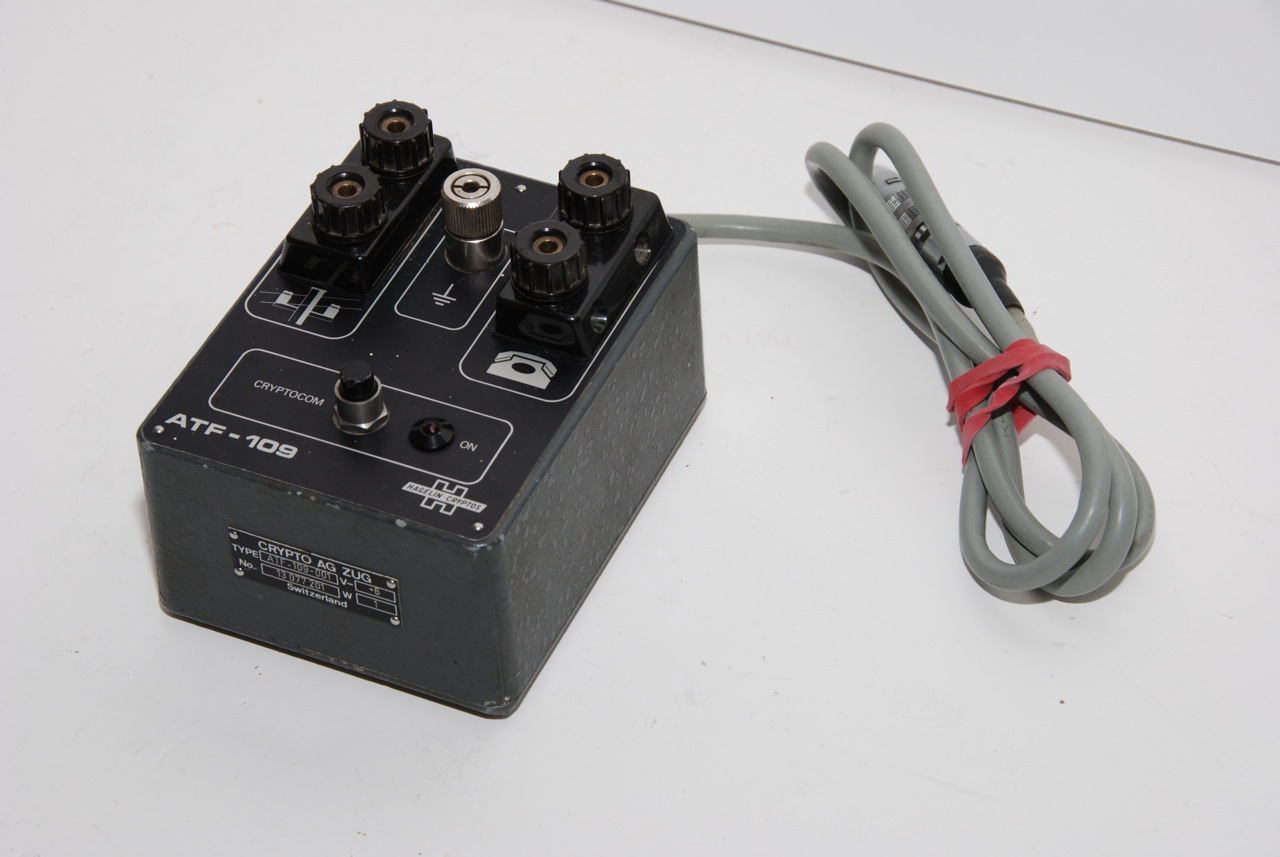
ATF-109 Telephone break-out box
|
|
|
|
In order to connect the CRM-008 to a telephone line, this small
break-out box was used. It has two sets of banana-sockets that are used
to connect to a standard (PSTN) telephone line and (optionally) to a telephone.
A fixed cable with a 10-way LEMO plug is used to connect the break-out
box to the DATA socket of the CRM-008.
|
|
|
|
|
|
ARA-100-001 Radio Interface/Speaker Unit
|
|
|
|
The CRM-008 can also be used over radio. In that case, a radio interface
is used instead of the telephone break-out box. The Radio Interface
has a 10-way LEMO plug that connects to the DATA socket of the CRM-008.
The radio is connected to the rear of this unit, by means of two fixed
wires (which are missing from the unit shown here).
|
|
|
|
|
|
ARA-100-002 Radio Interface
|
|
|
|
This unit is simular the the ARA-100-001 (shown above) but is missing the
internal speaker. Instead it has a socket for headphones.
A fixed cable with a 10-way LEMO plug is used to connect
it to the DATA-socket of the CRM-008.
Furthermore, the radio interface has two short cables for connection to
a military radio set. Both cables have a 13-way military BENDEX plug, one
male, and one female.
|
|
|
|
|
When using the CRM-008 over a radio link, this military-grade
handset should be connected to the phone socket of the CRM-008,
by means of an 8-way LEMO plug (just like the ATF-114 crypto phone).
|
|
|
|
|
|
PSM-106 Power Supply Unit
|
|
|
|
|
The CRM-008 can be connected to just any DC power supply with
a voltage between 12 and 30 Volt. The one supplied with the unit
is shown here. At present it is not known exactly how it connected
to the CRM-008, as the DC power cable is missing.
|
|
|
|
|
|
|
Any links shown in red are currently unavailable.
If you like this website, why not make a donation?
© Copyright 2009-2013, Paul Reuvers & Marc Simons. Last changed: Saturday, 08 February 2014 - 21:13 CET
|
 |

|
|