|
|
|
|
|

|
Fax encryptor
The CRYPTOFAX HC-4220 was a fax encryptor developed by Crypto AG
in Switzerland in the early 1990s. It allowed facsimile messages to be sent
securely by any Group 3 fax unit via standard PSTN (analogue) telephone lines,
at speeds between 2400 and 14,400 baud.
The HC-4220 was available from 1994 until 2002 [4] when it was replaced by
its successor the HC-4221 [2]
[3]. The backwards compatible HC-4221 is smaller and is still available from Crypto AG today (2011).
|
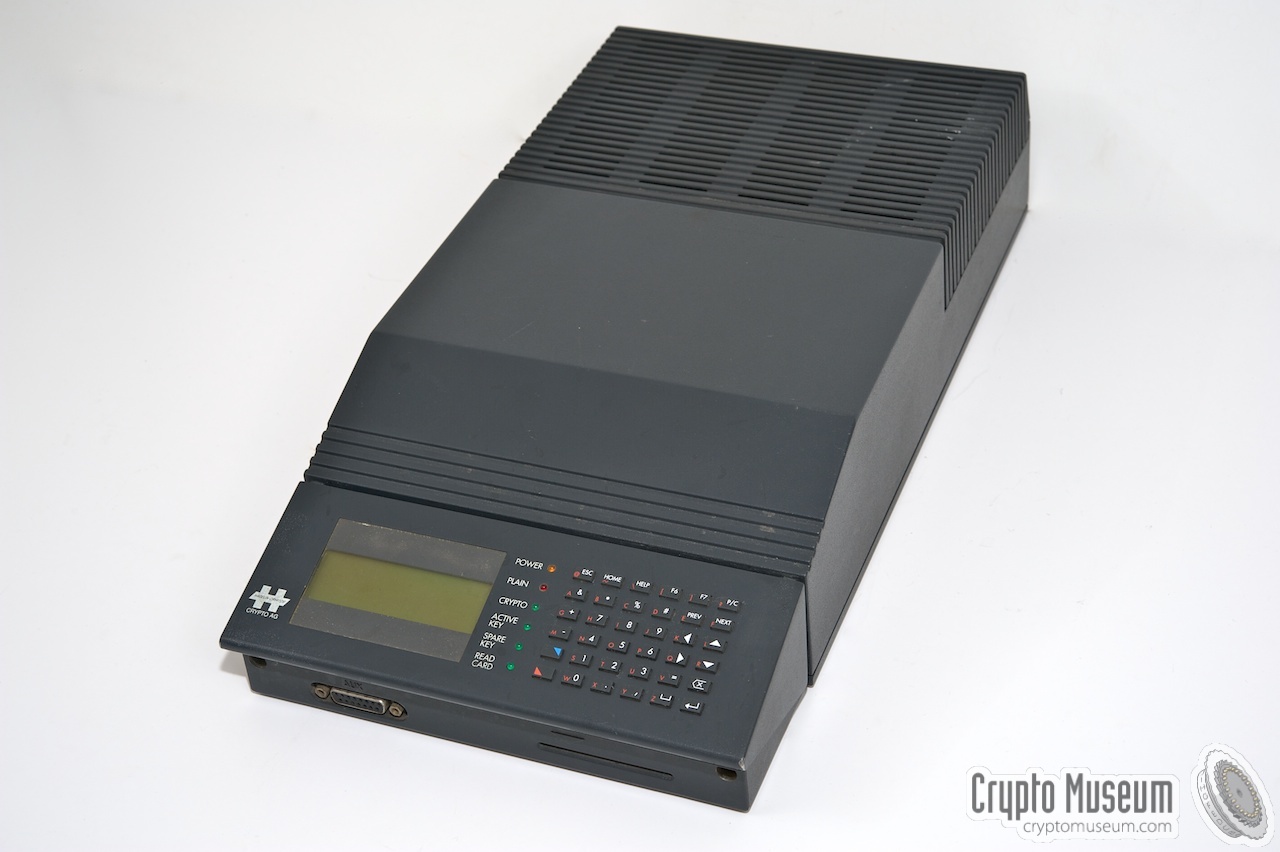
The HC-4220 is housed in a sturdy die-case aluminium case that consists of
two parts: the main unit and a detachable control panel. The control panel
consists of a 36-key rubber keypad, a 4-line LCD display and a built-in
card reader at the front. Beteween the display and the keypad are 6 status LEDs.
The image on the right shows the control panel of a typical HC-4220 unit.
It is shown here with a smart card present in the card reader at the front.
The menu-driven unit requires passwords for system manager (SM)
and operator (OP).
|
|
|
When turning the device on, it first performs a self-test. After approx. 10
seconds it is ready for use. If the battery in the controller is flat,
the real-time clock (RTC) and the actual settings will have been lost.
As a result, the unit resets itself to the factory defaults and the user
is prompted to enter the new configuration.
|
|
|
|
|
|
|
The smart card can be used to transfer the cryptographic keys, but it is also
possible to enter the keys manually via the control unit.
Separate passwords are used for the system manager (SM) and the operator (OP).
Crypto Keys (CK) can only be entered by an authorised person and consist
of 21 hexadecimal characters (256 bits). Once a key is entered, it needs to
be activated before it can be used. Once this is done, the LED 'Active Key'
on the control unit will be lit.
If the keys are lost, it is possible to reset the entire device, but that
involves deleting all cryptographic keys as well. All keying material is held
in a battery-backed RAM inside the crypto unit. The backup battery is a
non-rechargeable 3V Lithium cell that lasts for several years before it needs to
be replaced.
|
The rather large HC-4220 consists of a sturdy die-case aluminium case.
The top part is taken up by a compact power supply unit (PSU) that can be
removed without disassembling the rest of the unit.
The interior can be accessed by removing 6 bolts from the bottom
and taking off the lid.
|
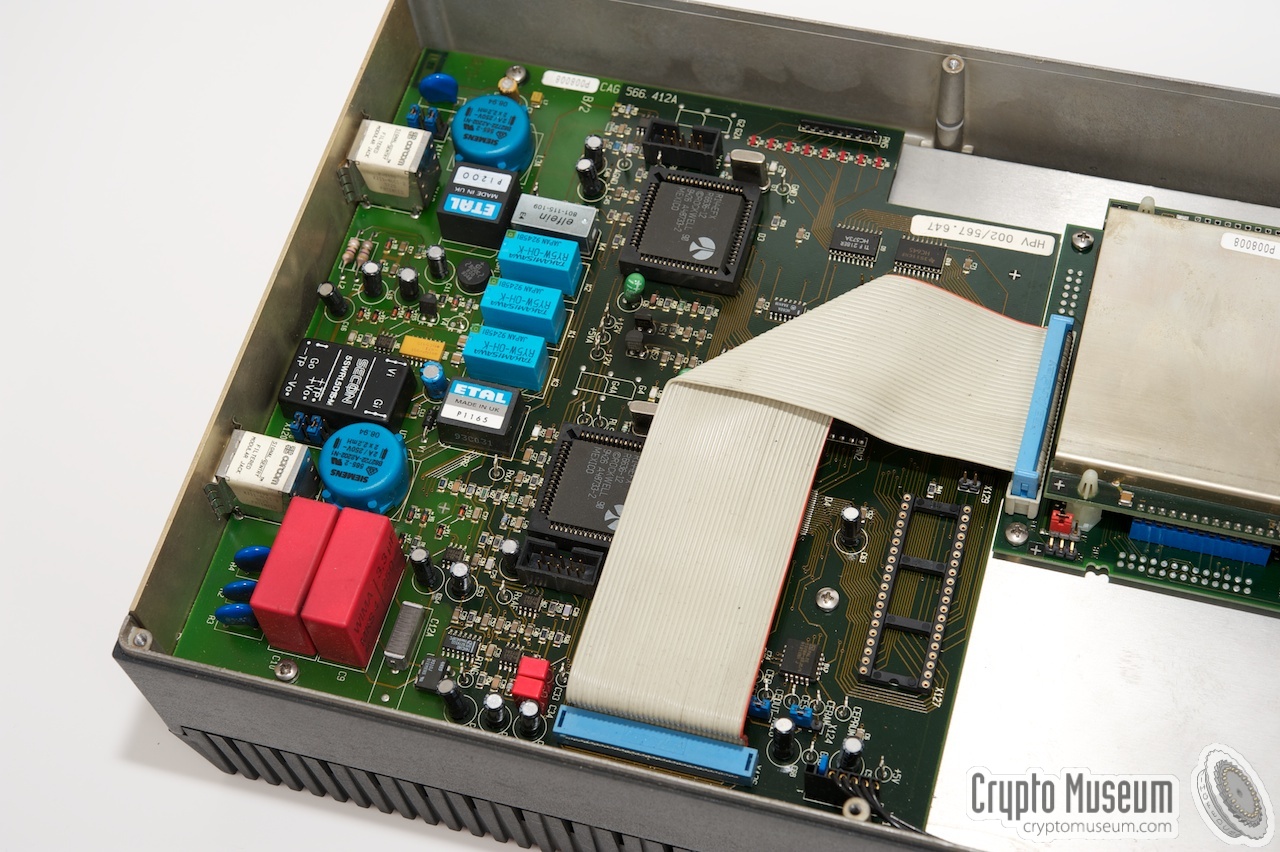
The image on the right shows the interior as seen from the bottom.
The largest board (left) is the modem, featuring various Rockwell modem chips
and some analogue electronics for connection to a PSTN line.
Just visible at the right is the crypto unit,
which is implemented as a closed rectangular
block which can not be accessed. Below the crypto unit is the
interface to the controller.
The interface also contains the backup battery for the crypto keys that are
stored inside the crypto unit.
It is the large blue block at the left.
|
|
|
As the required 3V Lithium batteries are sometimes very difficult to obtain,
the PCB has been designed in such a way that different types of batteries can
be used, varying from the rectangular blue block shown here, to circular
batteries and batteries with flying wires.
|
In August 2011, we required two surplus HC-4220 units.
One unit appeared to be operational.
The second unit had been under water for some time and had some
components seriously damaged. This unit has now been repaired to the best of
our abilities. However, we can not test the units at present, as we don't have
the manual and don't known how to operate it. If you have more information,
please contact us.
|
|
|
|
Any links shown in red are currently unavailable.
If you like this website, why not make a donation?
© Copyright 2009-2013, Paul Reuvers & Marc Simons. Last changed: Sunday, 03 June 2012 - 15:40 CET
|
 |

|
|