|
|
|
|
|

|
The image on the right shows a typical black
Motorola SECTEL 2500.
It is suitable for the transmission of voice and data at
2400, 4800 and 9600 baud, using a variety of compression techniques and
encryption/decryption methods.
The phone is very easy to operate.
It contains a standard keypad with the numbers 0-9, plus '*' and '#'.
A large crisp display at the top is used for interaction with the user.
Just below the display are 16 pre-defined function keys. They are used, e.g.,
to switch between SECURE and CLEAR modes, and to set the audio volume.
|
|
|
Below the function keys are 16 user-definable keys that can be used to
store frequency used phone numbers or functions.
Memory). They user could write down
the names of the memory locations on a small piece of paper, but it is
also possible to use a plastic inlay that fits in between the two rows
of memory keys (not present in the image above).
|
Click any of the above images for additional information about each model.
|
A STU-III phone can be connected to any standard analog telephone line
(POTS). A call is always initiated in non-secure mode. In order to
go secure, both parties have to insert and activate their unique
Crypto Ignition Key (CIK). Then, one of the parties initiates
the secure conversation by pressing the Secure button.
After a 15 seconds delay, during which the message keys are exchanged
and the phones are synchronised, a secure conversion is possible.
The 10 to 15 second delay is common for all STU-III phones and can be
considered a nuisance to the user. Furthermore, valuable information is
often given away in the clear voice conversation that takes place
before secure mode is entered.
This is not the case with the later (fully digital)
Secure Telephone Equipment (STE).
Until today, there have been no reports of STU-III units being broken.
That does not mean, however, that foreign intelligence services did not
gather valuable information from intercepted lines, directly before
and after the secure part of the conversation.
|
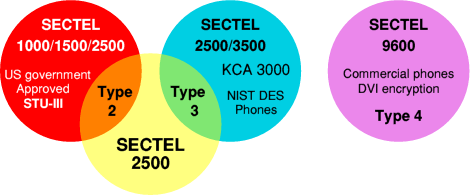
To suit the various customers and their safety requirements, different
SECTEL models were manufactured. They all use the same enclosure and
operation is more or less identical. The diagram below shows the positioning
of the various SECTEL models.
|
Type 1 products use classified encryption algorithms and are intended only for
US government use at the highest level. Type 2 products use unclassified
encryption algorithms endorsed by the NSA. They are used
for protection of sensitive information between government agencies and
approval from the US or Canadian government is required.
Type 3 products use an unclassified, fully comercial encryption algorithm
that is used for protection of sensitive or company-proprietary information.
Type 3 is also referred to as NIST Standard DES. It is only sold to US
government contractors and approved companies.
The SECTEL 2500 can use both Type 2 and Type 3 encryption.
The SECTEL 9600 is the only phone in this family that uses
Type 4 encryption.
It is intended for unclassified, non-sensitive information between
companies. It uses a non-classified, fully commercial encryption algorithm.
It can be sold to all countries except those that are on the US hostile list.
|
|
|
Presidential communication
|
 |
|
|
For a president, communication with his ministers and advisors
is paramount. In the past, the STU-III has proved to be a major
'lifeline' for various presidents whilst travelling through the
country or during overseas visits.
Generally, a couple of STU-III
phones were installed by the US Secret Service,
at any likely or unlikely location that the president
could possibly visit that day.
As the STU-III had an analogue interface, it could be connected to any
POTS telephone wall socket anywhere in the world, allowing a secure conversion
over a non-secure telephone line, up to the level of Top Secret.
For this reason, the later STE
phone still supports analogue connectivity.
The long life-span of the STU-III is illustrated by the fact that
it served four US Presidents: Ronald Reagan,
George H. W. Bush (Sr),
Bill Clinton
and George W. Bush (Jr).
Although it is quite possible that the suceeding president,
Barack Obama, also used the STU-III, there is no photographic evidence
of this. Obama is known to have made extensive use of the
STE, which was introduced around the time
he was installed as the 44th President of the United States.
|
Ronald Reagan served two successive terms as the 40th President of
the United States (1981-1989). During this time he became known as
a strong supporter of secure communications. He endorsed, for example,
the use of the STU-II secure phone at all levels
of the US Government and the Department of Defense (DoD), and made
funding available for the development of the
STU-III.
President Ronald Reagan using an early (white) Motorola STU-III. © NSA [3]
Towards the end of Reagan's presidency, the STU-III entered service
and soon became a beste-seller in government circles. Eventually more
than 100,000 units would be ordered. The image above shows President
Ronald Reagan using one of the first Motorola Type 1 STU-III phones.
|
|
|
President George H. W. Bush
|
|
|
|
The first president to use the STU-III after Ronald Reagan, was
George H. W. Bush. His administration was in office from 1989
to 1993 and used the secure phone on many occasions throughout
the entire presidency. Bush, who was Vice President under Ronald
Reagan (1981-1989) was well aware of the security aspects involved
with secure communication.
President George H. W. Bush (Sr) using a black Motorola STU-III. © NSA [4]
The image above shows President George H. W. Bush using
a STU-III that is placed on a small table aside his chair.
The sign below the table reads: 'SPECIAL TELEPHONE FOR
PRESIDENTIAL COMMUNICATIONS'. Although the protograph was taken
during his presidency, the exact date and place are currently unknown [4].
Neither do we known what the white device at the bottom is.
|
William Jefferson (Bill) Clinton served two terms as the 42th President
of the United States (1993-2001).
Although the STU-III must have been used heavily during the Clinton
administration, we have not found any photographic evidence
that shows Clinton using such a phone.
If you have one, you can help use by sharing it with us.
|
9/11 Attacks at the World Trade Center
On 11 September 2001, the two largest towers of the World Trade Center
in New York (USA) were attacked by terrorists. When it happened,
president George W. Bush was visiting
Emma E. Booker Elementary School in Sarasota (Florida).
As the Secret Service had already installed a readily available
STU-III unit in a nearby room, President Bush was able to speak with his
security staff in Washington only moments after the first impact.
Official White House Photograph by Eric Draper [1]. 11 September 2001.
The image above shows President George W. Bush using his
Motorola SECTEL STU-III phone in the
foreground, whilst the attack on the second tower is visible on a TV
screen at the back.
The photo is part of a series of three photographs (see below) that
were made by White House photographer Eric Draper at the event [1].
Click for a larger view.
On 9 September 2011, exactly 10 years after the attacks, CNN released
an interview with Eric Draper, who at the time was President Bush's
personal photographer at the White House. In the interview, several
of Eric's photographs, taken on 9/11, are shown alongside CNN footage.
 Interview with Eric Draper Interview with Eric Draper
|
|
|
|
|
|
|
- SECTEL 1500, Type 1, sold for US$ 1800
- SECTEL 2500, Type 2, sold for US$ 2145
- SECTEL 3500, Type 3, sold for US$ 3395
- SECTEL 9600, Type 4, sold for US$ 4495
|
|
|
|
Any links shown in red are currently unavailable.
If you like this website, why not make a donation?
© Copyright 2009-2013, Paul Reuvers & Marc Simons. Last changed: Sunday, 21 April 2013 - 14:07 CET
|
 |

|
|


![Ronald Reagan using a STU-III telephone [4]](../../usa/stu3/img/reagan_full.jpg "Ronald Reagan using a STU-III telephone [4]")


