|
|
|
|
|

|
High-speed link encryption device (8Mb/s)
SATCOLEX was a High Speed Link Encryption device for bundled (multiplexed)
telephone and teleprinter data,
developed by Philips Usfa BV
in 1976 for NATO evaluation HISPEED. Although Satcolex was fully developed
and was ready to enter the evaluation stage, it was withdrawn in return
for co-production of the American WALBURN (KG-81)
Trunk Encryption Device (TED).
|
Satcolex allowed bundled data from a Time Division Multiplexer (TDM)
to be sent over radio links at speeds up to 8Mb/s in full-duplex.
In order to encrypt and decrypt data at the same time, it contained
two separate key-stream generators that were based on the daily key.
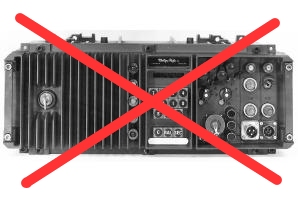
A complete system consisted of the main Satcolex unit, an interface
unit and various cables. The main unit was housed inside the same
cabinet as the earlier Mucolex. This would allow easy migration to the
new standard.
|
|
|
Development of Satcolex was started in 1975 when NATO was looking for
a high-speed trunk encryption device. As part of NATO evaluation HISPEED,
Philips developed the next generation of their well-known
MUCOLEX. The unit would be compatible with existing
equipment, such as the DeltaMux TDM,
but would offer full-duplex at 8Mb/s compared to 1Mb/s before.
Although Satcolex was fully functional in 1976,
it was withdrawn from the evaluation in 1977, in favour of the 20Mb/s American
KG-81 (WALBURN) Trunk Encryption Device (TED).
In return, Philips was offered co-production of the KG-81,
a project that became known as HISPEED.
By the end of 1982, Philips had delivered over 95 complete systems to NATO,
each with several KG-81s.
The knowledge gathered from the Satcolex project was later used for the
development of the 2Mb/s MUCOLEX II (BVO-M)
as part of the ZODIAC Radio Network
for the Dutch Army. At the same time, Philips developed the 2Mb/s
MUCOLEX III (BVO-T) that was compatible with the
KG-81 (WALBURN). It would be used within
ZODIAC for communication
with NATO Allies.
|
The basic SATCOLEX system consisted of the actual Satcolex cipher
unit, housed in the same case as a MUCOLEX, and an interface unit
that was about half the size of the Satcolex. The interface unit
adapts both the input signals and the output signals of the Satcolex
to the required levels.
The block diagram above shows how the various components were
connected together. At the left is the (DeltaMux) TDM equipment.
At the right is the full-duplex radio link. The Satcolex itself is
situated at the bottom. All input and output signals are processed
by the interface unit that has strict RED/BLACK separation.
|
- UA-8231 - Main Satcolex unit
- UA-8232 - Interface Unit
- UA-8233 - Cable Assembly (to clear compartment of interface)
- UA-8234 - Cable Assembly (to crypto compartment of interface)
- UA-8235 - Cable Asssembly (to TDM unit)
- UA-8236 - Cable Assembly (to line adapter)
|
- Philips Usfa BV, High Speed Link Encryption SATCOLEX Operating Instructions
UA-8119. Doc. nr. 13933/E576. May 1976.
|
|
|
|
Any links shown in red are currently unavailable.
If you like this website, why not make a donation?
© Copyright 2009-2013, Paul Reuvers & Marc Simons. Last changed: Saturday, 08 February 2014 - 21:57 CET
|
 |

|
|