|
|
|
|
|

|
Key transfer device
- Wanted item
The UP-2101 was a small electronic transfer device
for the
distribution of cryptographic material (key-filler),
commonly referred to as Transmission Encryption Keys (TEK).
It was developed by Philips Crypto in Eindhoven (Netherlands)
in 1992, as the successor to the UP-2001,
which in turn was an alternative to the rather
limited KYK-13 filler.
Despite its potential, only a small quantity was ever produced.
It was used for example with the Philips
Spendex 40 crypto phone.
|
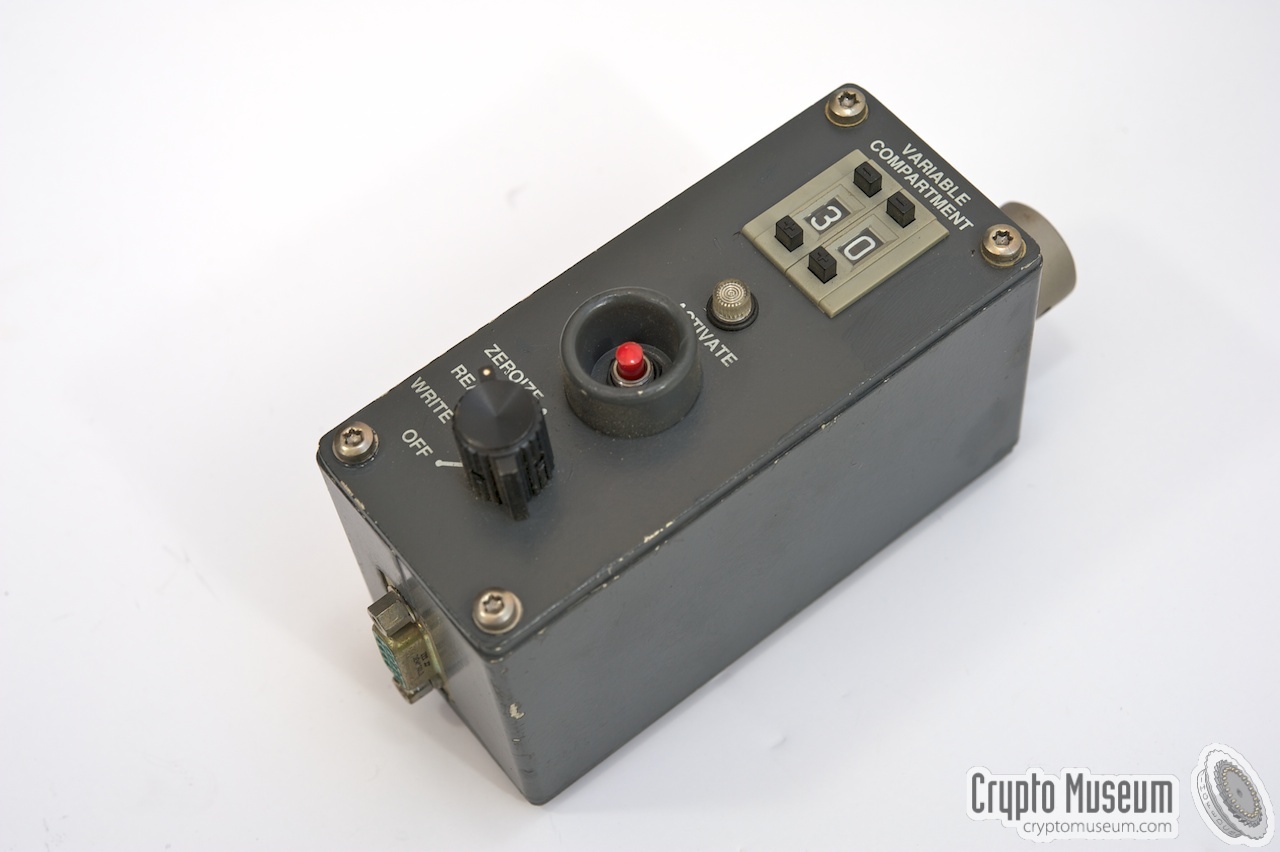
The image on the right shows a prototype of the UP-2101. It is similar
in appearance and size to the American KYK-13
and uses the same U-283 socket for connection to the equipment [1].
It has a rotary switch that is used to select the mode of operation.
At the center is a red ACTIVATE button that is used in combination with
a particular setting of the mode selector.
The mode selector is also used for reading keys via the DB9 connector at
the bottom and writing them to the U-283 connector at the top.
|
|
|
It has some important improvements over the KYK-13 however. First of all
is has room for 40 sets of key variables (compartments),
whereas the KYK-13 has only 6.
The required key compartment is selected by setting the 2-digit selector
at the top to the corresponding number (00-39).
This greatly increases the number of keys
that can be carried around at any time.
Another advantage is the presence of a standard serial RS-232 interface that
allowed the connection of a data-entry device, such as a barcode reader.
It was suggested that the crypto-keys could be printed on a sheet of
paper each day as a set of barcodes. The sheet could then be faxed to a
destination, using a PFDX fax encryptor,
a Spendex 40 phone
or a Spendex 50.
This way, the keys could be distributed securely.
The UP-2101 supported a standard HP barcode reader.
Loading the keys into the right compartment of the UP-2101 was a matter of
seconds.
|
|
|
|
|
|
|
The UP-2101 used the DS-102 protocol,
developed by the NSA,
and was suitable for all Usfa/Crypto-developed military encryption devices,
such as the Spendex 40,
Spendex-50 (DBT)
and the Trunk Encryption Device BVO.
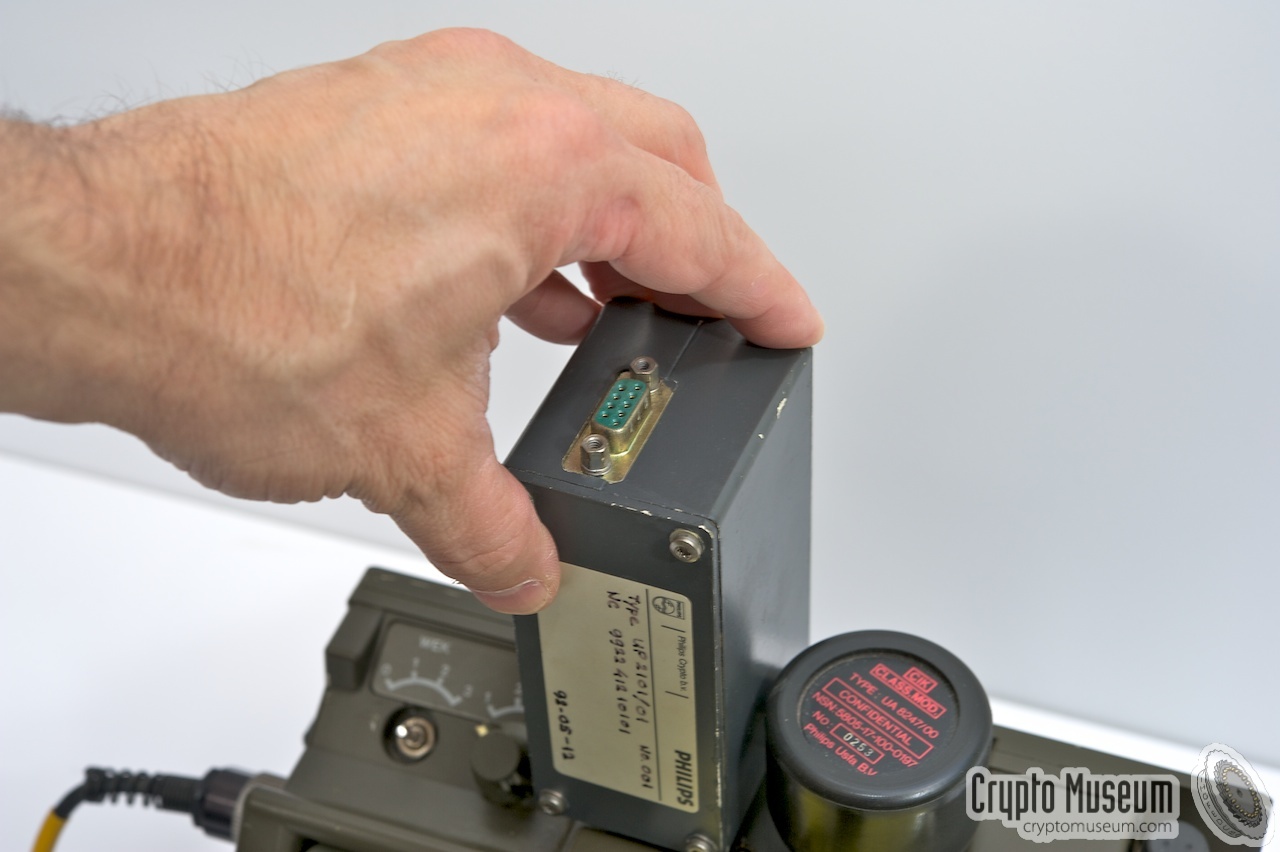
The rightmost image above show the UP-2101 being used with
a Philips Spendex 50.
It is fitted directly to the FILL connector of the Spendex 50.
|
Keys can be loaded into the UP-2101 by means of a (DOS) PC running the
UP-2002 Net Key Program (NKP) software.
For this, the DB9 connector of the UP-2101 was connected to the COM1 port
of the PC via a simple 2-wire cable. Keys were generated by the NKP
and were then transferred to the UP-2101 via the serial port, one at a time,
each with a suitable checksum.
It was also possible to load keys into the UP-2101 via barcodes, by using
an HP HBCR-8300 barcode reader.
The UP-2002 NKP (see above) could be used
to print suitable barcodes onto paper. This allowed the keys to be sent
securely by means of a (trusted) courier, or via a fax unit connected to
a secure crypto telephone, such as the Spendex 40.
|
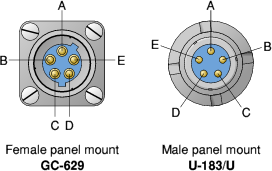
The UP-2101 uses a 5-pin U-229 type connector for connection to the
crypto device, rather than the more common 6-pin U-284. Is it nevertheless
compatible as the extra pin (F) is not used. The table below shows the
pin-out of the connector. More information on the special
U-229 page
[2].
|
|
Pin
|
DS-102
|
Description
|
|
|
|
|
A
|
GND
|
Ground (common wire)
|
|
|
B
|
-
|
Not used
|
|
|
C
|
ACK
|
FILL request acknowlegment
|
|
|
D
|
DATA
|
Fill data into radio or crypto device
|
|
|
E
|
CLK
|
Fill clock into radio or crypto device
|
|
|
F
|
-
|
-
|
|
|
- Identification: UP-2001 or PKMX-2001, Philips Usfa BV, Fill Gun
- Storage capacity: 40 keys
- Transmission: serial asynchronous (DB9) or synchronous (U-183U)
- Asynchronous data: 9600 baud (DB9)
- Synchronous data: conform DS-102 (U-183U) 1bps-5kbps (RX), 1.6kbps (TX)
- Dimensions: 125 x 50 x 71 cm
- Temperature range: -20 to +45°C (operating), -25 to +60°C (storage)
- Power supply: 2 x UA-6303 lithium cells (3.6V each)
|
|
|
|
Any links shown in red are currently unavailable.
If you like this website, why not make a donation?
© Copyright 2009-2013, Paul Reuvers & Marc Simons. Last changed: Sunday, 22 July 2012 - 22:54 CET
|
 |

|
|