|
|
|
|
|

|
Voice Encryption Unit
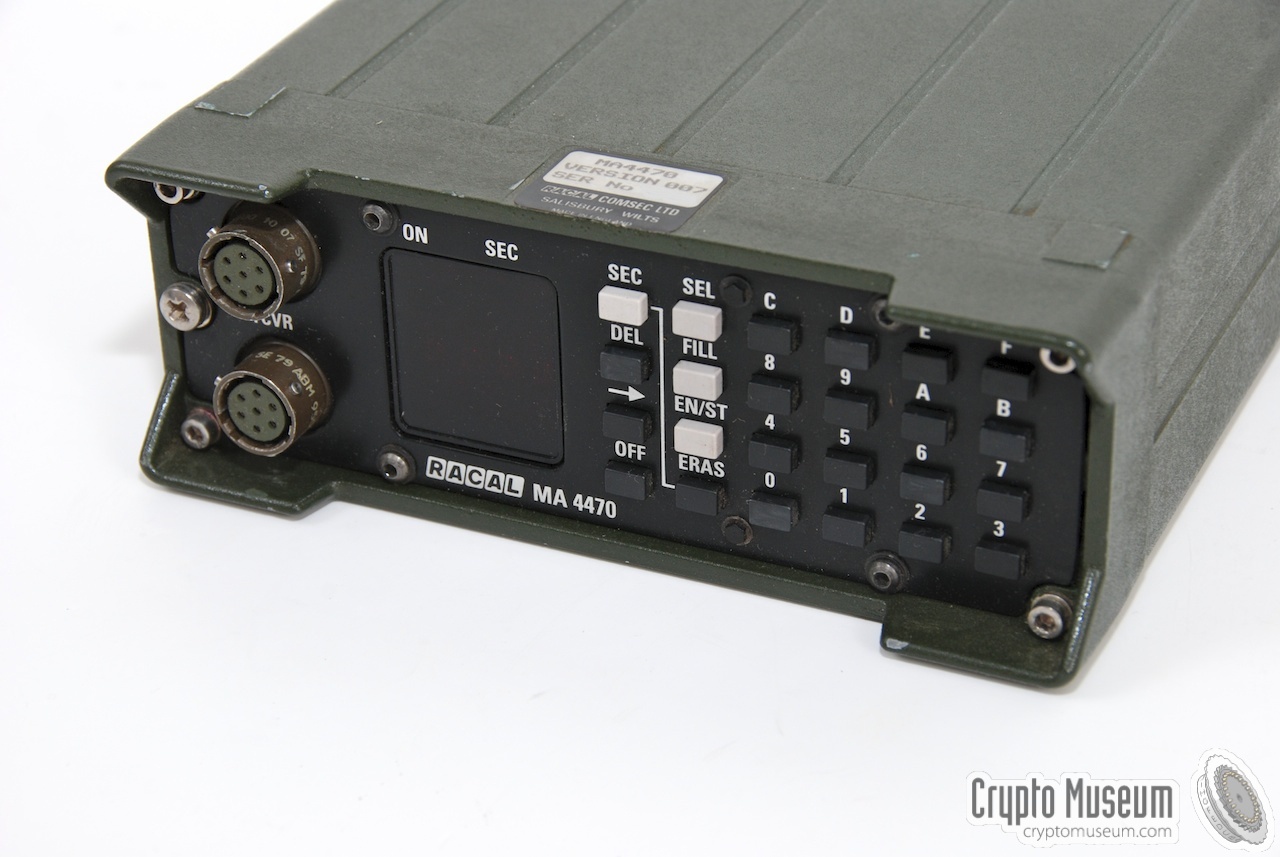
The MA-4470 was one of the last high-grade voice encryption units to be
developed an manufactured around 1996 by Racal COMSEC Ltd
in the UK, before the company was sold to Thomson CSF (now Thales) in 2000.
A civil telephone variant is known as the MA-4471.
|
The unit is smaller than any of its predecessors and measures just
16 x 6 x 21 cm. It is inserted between the handset and the transceiver
and allows voice signals to be encrypted using a combination of
Time Element scrambling and Frequency Processing, in half-duplex [1].
The MA-4470 employs a novel continuous synchronisation system that
allows late-entry and that is virtually transparent to the
user when switching ttransmission direction of the half-duplex link.
The unit can be powered by the host radio set, or by an external
power supply unit.
|
|
|
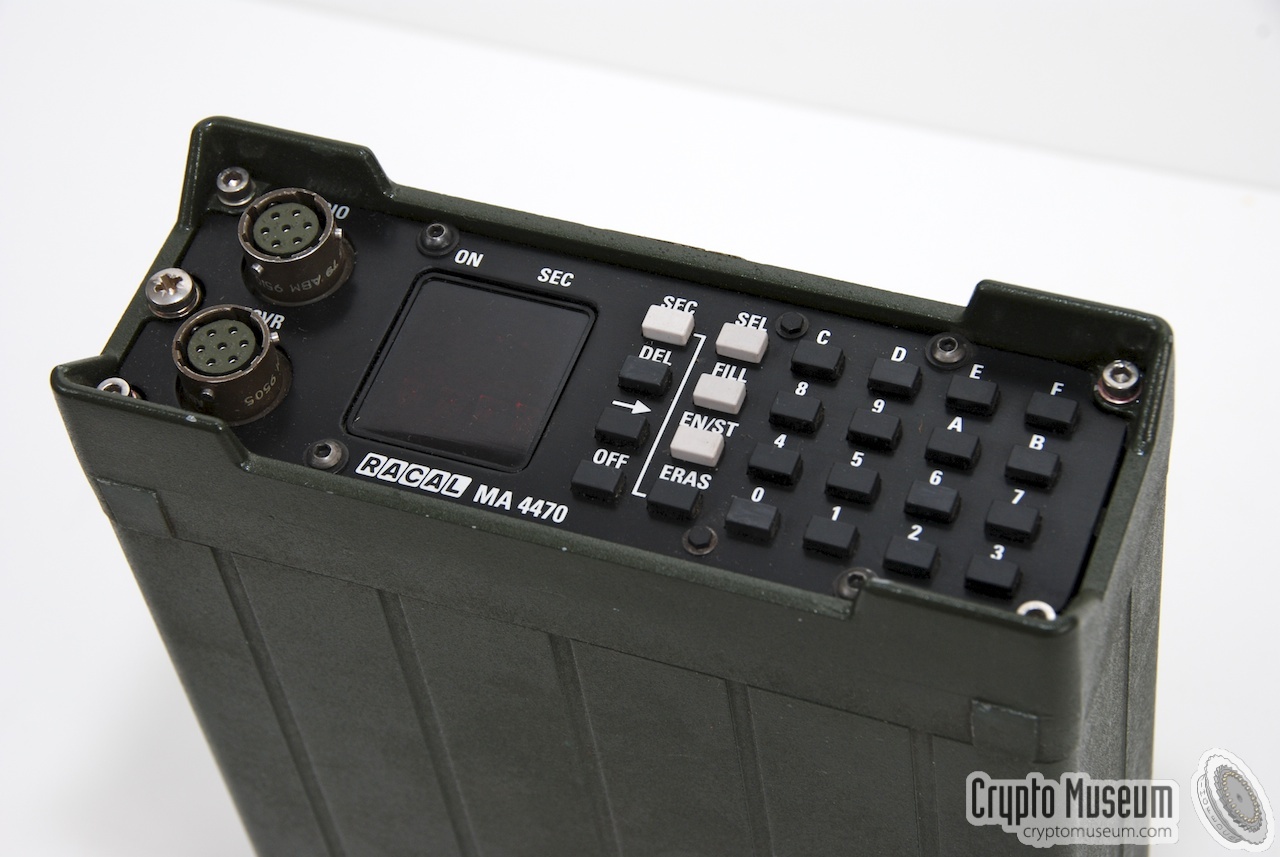
All controls and connection are at the front panel.
At the left are the sockets for the handset (or headset) and
the transceiver. To the right of the sockets is a 4-character
LED display and some LED indicators that are used for user feedback.
The right half of the front panel is taken by the 25-button rubber
keypad, which is used for switching between clear and secure,
entering the base key, using the fill-gun, selection of the current
key and ereasure of the key(s).
|
The cryptographic keys are 80-bits long and can be entered
by typing 20 hexadecimal digits on the keypad.
Alternatively, the keys can be entered using a suitable
key-fill device (fill-gun), such as the MA-4255 Master Programmer
or the MA-4459 Slave keygun [1].
The image on the right shows the
Racal MA-4083 fill-gun that looks similar
to the MA-4459 slave keygun that is used with the MA-4470.
The MA-4255 Master Programmer is housed in the same case as the
MA-4225 portable encryptor.
|
|
|
|
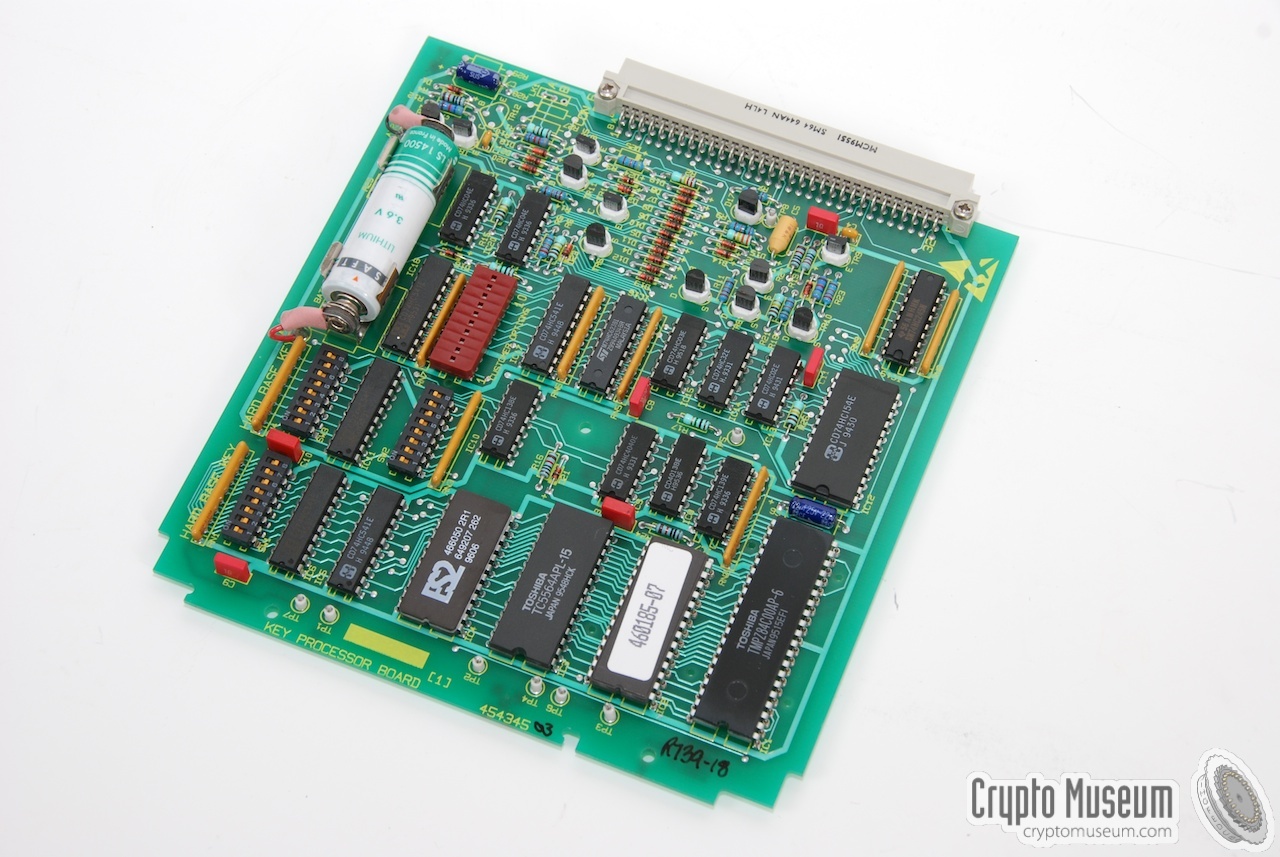
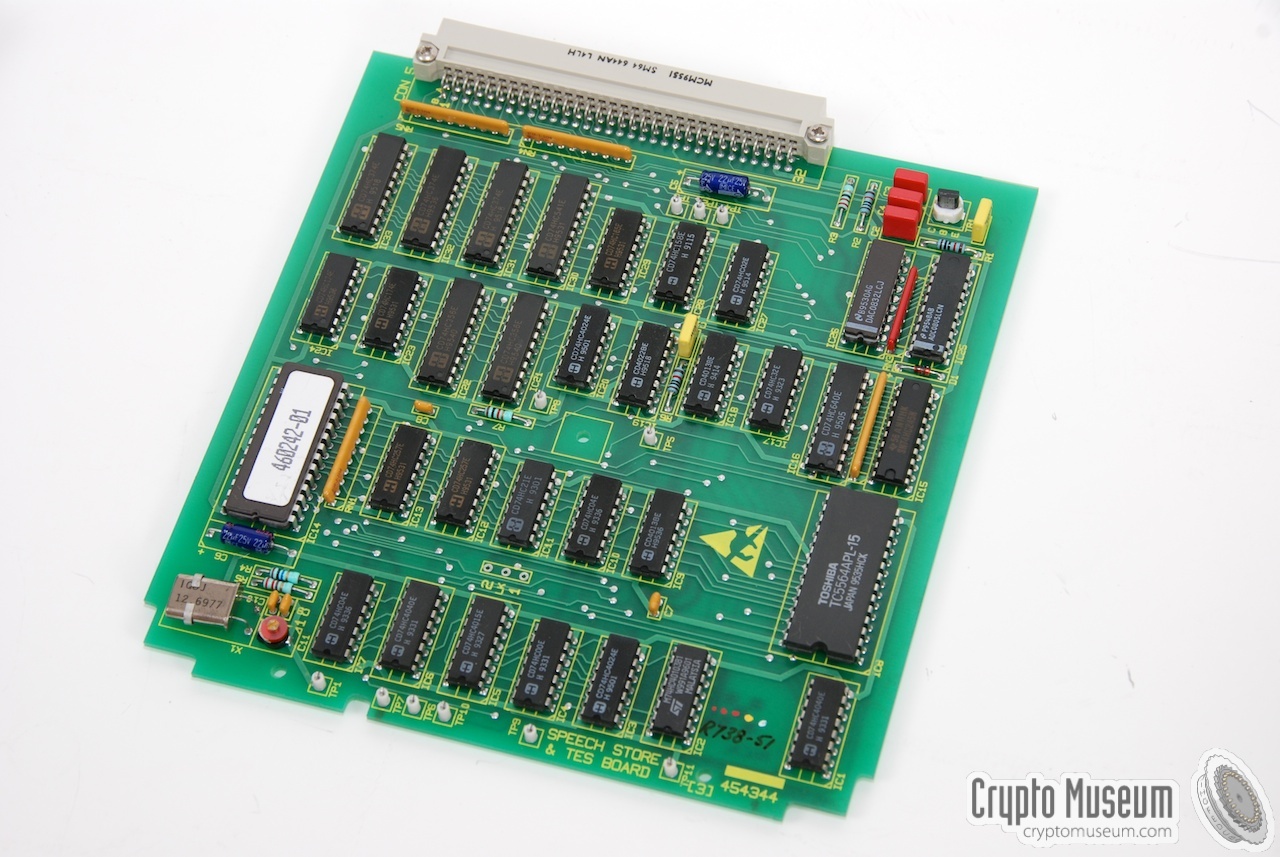
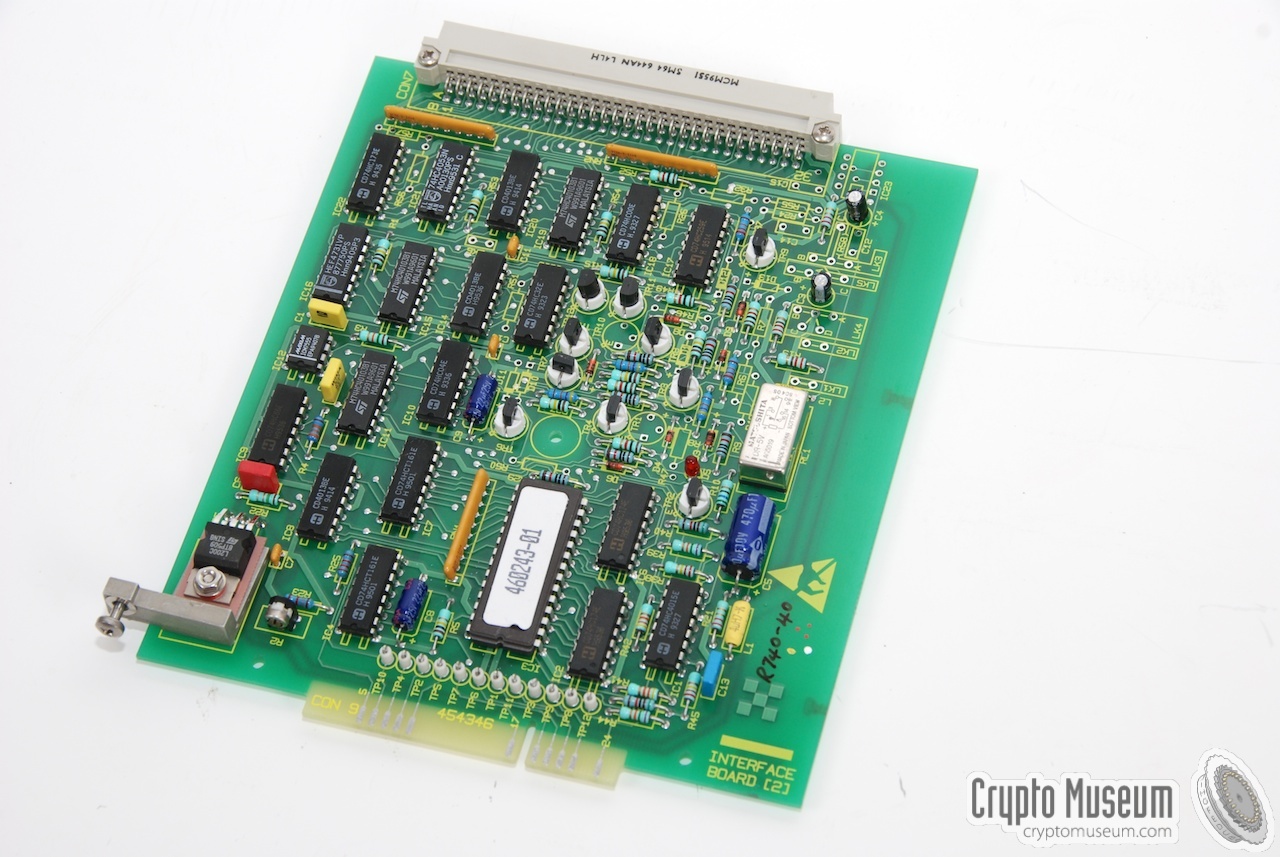
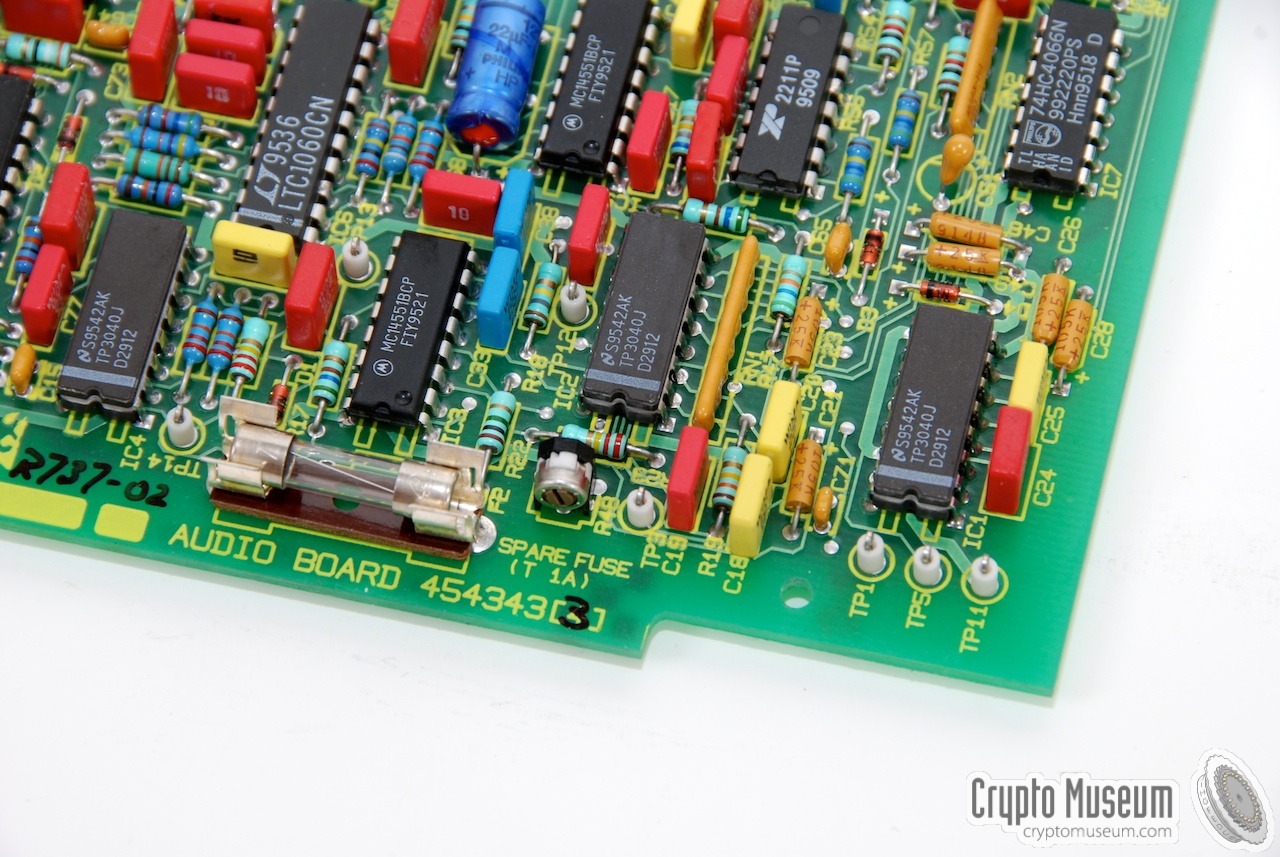
The front panel of the unit acts as a backplane for the four PCBs.
Each board uses a 64-way DIN connector for connection to the backplane.
A small metal bracked, that is usually stored in between the PCBs,
can be used to pull-out the individual boards.
The image on the right shows the processor board, which is the 2nd board
from the top, half-way out of the case. The metal bracket is shown here
in front of the PCB. Detailed pictures of each board can be found below.
|
|
|
|
|
|
|
|
|
|
- Technique: Time Element scrambling and Frequency processing
- Keystream: non-linear keystream generator
- Total number of keys: 8·1031
- Internal key settings: 26 bits
- Base key: 80 bits per key (from fill-gun) or 20 hex digits (via keyboard)
- Stored keys: 16 base keys + 1 guard key (selectable via keyboard)
- Key period: 1024 bits
- Message key length: 24 bits
- Transmission: FSK in frequency processed channel at 48 baud
- Message key cycle time: > 90 days
- Key storage battery life: 5 years
- Audio bandwidth: 400Hz - 2400Hz
- Required channel bandwidth: 400Hz - 2700Hz
- Audio delay: 495 ms
- Input level: TX: 0dB, 1mV - 50mV, RX: 70mV - 3.5V
- Output level: adjustable to match input level (max. 1.5W into 8 Ω)
- Power supply: 12V - 32V DC, 120 - 300mA
- Temperature range: -20°C to +65°C (operation), -40°C to +70°C (storage)
|
- MA-4255 Master Programmer
- MA-4459 Slave Keygun
- MA-4220 NiCd Battery for Master Programmer
- MA-4234 Battery Charger (230V AC) for Master Programmer
- MA-4454 Battery Charger (115V AC) for Master Programmer
|
-
Leaflet kindly supplied by Paul Ratcliffe, January 2013.
|
|
|
|
Any links shown in red are currently unavailable.
If you like this website, why not make a donation?
© Copyright 2009-2013, Paul Reuvers & Marc Simons. Last changed: Thursday, 17 January 2013 - 15:20 CET
|
 |

|
|