|
|
|
|
|

|
The first mixer machine
- wanted item
The T-43 was a One-Time Tape (OTT)
cipher machine for teleprinter signals
(telex), developed by Siemens & Halske
in 1943 and introduced in 1944,
close towards the end of WWII. Machines like the T-43 are commonly called
mixers, as they mix the clear text with data from a key tape.
The key tape is used as a One-Time Pad (OTP).
The T-43 was arguably the first machine in this class.
|
The official name for the machine is Schlüssel-Fernschreibmaschine
SFM T-43. It is based on the earlier T-37 teleprinter, and has a paper-tape
reader/puncher to the left of the keyboard.
For each character typed on the keyboard, a random character is read from
the key tape and mixed with the original character by means of an
XOR-operation. Once the key character is read from the
paper tape, it is destroyed by the built-in puncher, so that it can not be used
again.
Images of the T-43 are extremely rare and they all seem to originate from the
same -single- source. The image on the right is currently the best one
we have been able to locate.
|
|
|
The T-43 was codenamed Sägefisch (Sawfish) by the Germans,
because of the typical sound of its modulated signal.
The codebreakers at Bletchley Park called it
'Trasher'. It is currently unknown how the key tapes were produced and
distributed, but according to eye witness Georg Glünder,
the designers said that the tapes were created by Random Number Generators
(RNG) and that they did not have a cryptographic period [1].
The principle of the T-43 mixer machine is based on the so-called
Vernam Cipher invented by Gilbert Vernam in the US
in 1917. Gilbert Vernam was also the inventor of the stream cipher and
the co-inventor of the One-Time Pad (OTP). According
the NSA, it is probably one of the most important inventions in the
history of cryptography. Nevertheless the Germans were probably the first
to develop a practical implementation of it for the encryption of telegraph signals: the T-43.
|
The T-43 entered service relatively late in the war and only a modest number
of machines was built. It is believed that between 30 and 50 machines were
produced [3].
At the end of the war, some T-43s were found and confiscated by the Allies.
It is known that the American TICOM-commission shipped six T-43 machines
to the US and an equal number of German crypto-experts.
The machines that were captured in Norway, were shipped to
Bletchley Park (UK)
[3].
It will come as no surprise that the T-43 was kept secret by the Allies
for many years. Strangely enough though, the history of the machine is
still a mystery today.
At this time (2013) no surviving machines are known to the public and
further information from British and American archives has not yet been
released.
Shortly after WWII, the US, and later also the new Allied organisation
NATO,
started using ETCRRM mixer machines
that were based on the T-43 principle.
These machines were made by the Norwegian manufacturer
STK and sold to the US and to NATO.
|
If the key tapes that were used with the T-43, consisted of a truely
random sequence of characters, the machine would theoretically have been
unbreakable. According to [4] however, the key sequence was pseudo-random
as it was generated by two Siemens T-52e machines.
Another weakness was caused by TEMPEST problems.
The delay of the cipher relay caused a phase-shift between the clear text
and the cipher text, which was visible on an oscilloscope.
This unwanted side-effect was discovered by the German crypto-experts of
OKW-Chi.
As this allowed the clear text to be reconstructed from the transmitted
signal, extra filters were later added to the existing T-43 machines.
Meanwhile, Siemens developed an improved machine with a different
construction that would not exhibit the TEMPEST problem, but the war
had ended before that machine could be released.
It is not known whether or not the above weaknesses were exploited by
Bletchley Park, but no evidence to this effect has been found so far.
Cryptanalysts at BP initially thought that the key tapes were produced
by a Lorenz SZ-42 as they found regularities
in the key sequence. This is probably the reason why the codebreakers
chose a fish-name for this machine (Trasher).
|
Over the years, many have claimed to have invented the principle of
the mixer machine. In the late 1950s, the Dutch PTT filed a design for
such a machine that later became known as the
Ecolex cipher machine. Although a patent
was granted, they were by no means the first ones to have 'invent' it.
Several years earlier, in 1952, a similar patent was filed by Bjørn
Røhrholdt and Kåre Meisingset of STK
in Norway. That machine became known as the
ETCRRM and was soon one of the favorites
of the Americans. It was later used on the
Washington-Moscow hotline.
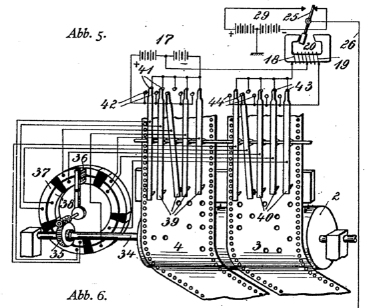
All these patents can be declared prior art as Siemens developed
the T-43 in 1943 and it was based on a (Siemens) patent filed back in 1921.
The image above shows part of the main drawing of
German Patent DE371087
in which the two tape readers are clearly visible side-by-side.
But even the German patent would probably not have survived a potential
lawsuit. It was the American Gilbert Vernam
who filed his design for the same concept first, on 13 September 1918.
Although his drawings are not identical to the drawing of the German patent,
there are some remarkable similarities. In the patent, Siemens recognizes
earlier developments in this field and adds online use to it.
The T-43 might therefore be the first to use it for online encryption.
|
Please note that this page is still under construction and that it currently
only acts as a placeholder for information about the Siemens T-43.
If you have any information about this machine that you can share,
please contact us.
|
|
|
|
Any links shown in red are currently unavailable.
If you like this website, why not make a donation?
© Copyright 2009-2013, Paul Reuvers & Marc Simons. Last changed: Tuesday, 07 May 2013 - 10:08 CET
|
 |

|
|