|
|
|
|
|

|
Pin-wheel cipher machine
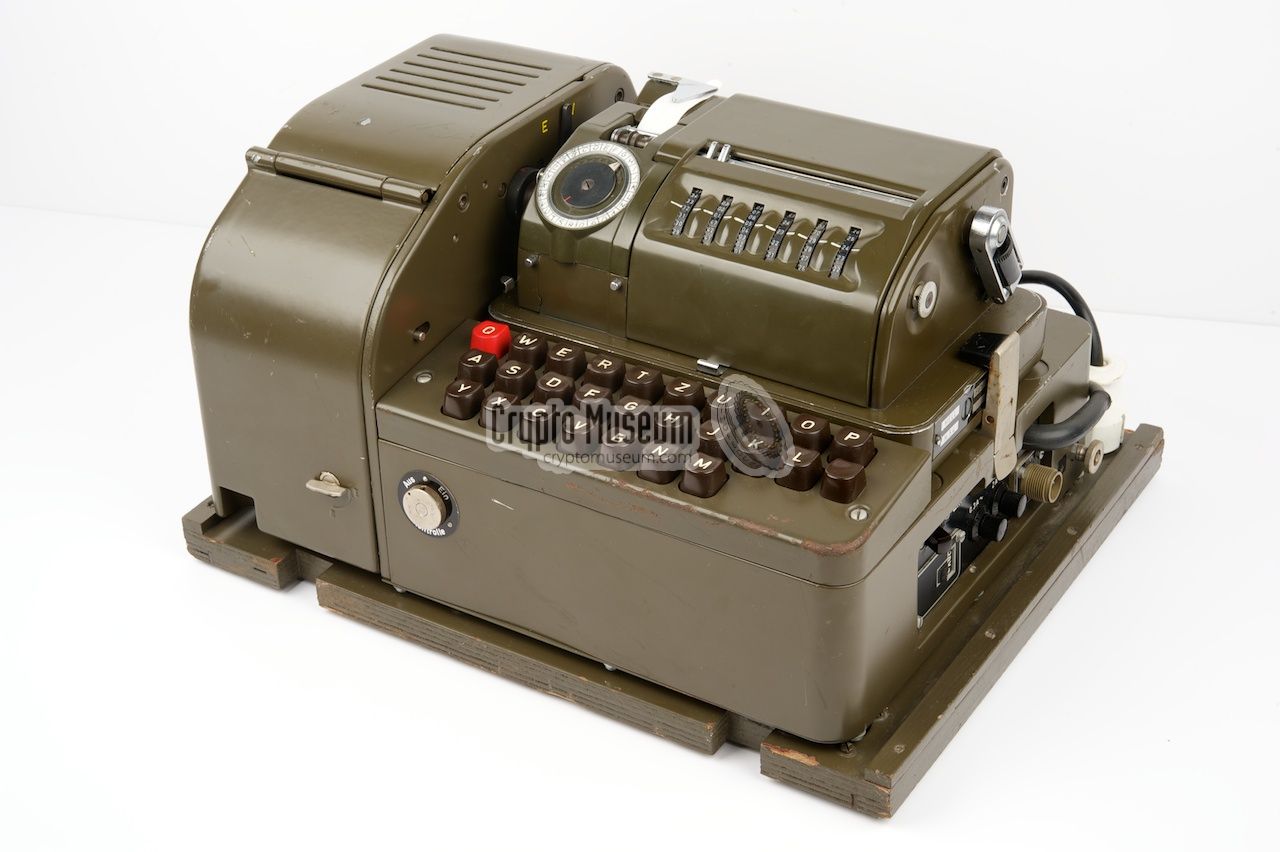
The H-54 was a mechanical pin-wheel
cipher machine, built in the
mid-1950s by Rudolf HELL
in Kiel (Germany) for the German Bundeswehr (Army).
It was a functional replica of the
Hagelin CX-52 and was built under
licence from the Boris Hagelin Company
(now: Crypto AG) in Switzerland.
The machine is interoperable with the HELL STG-61
(and therefore also with the Hagelin CD-57).
|
Nevertheless, HELL managed to improve several aspects of the machine
and make it easier to operate and more relibable. As the machine was built
for the army, it is slightly more robust than the
original CX-52
design. Furthermore, the storage case houses all
spares and maintenance tools that were required for daily use.
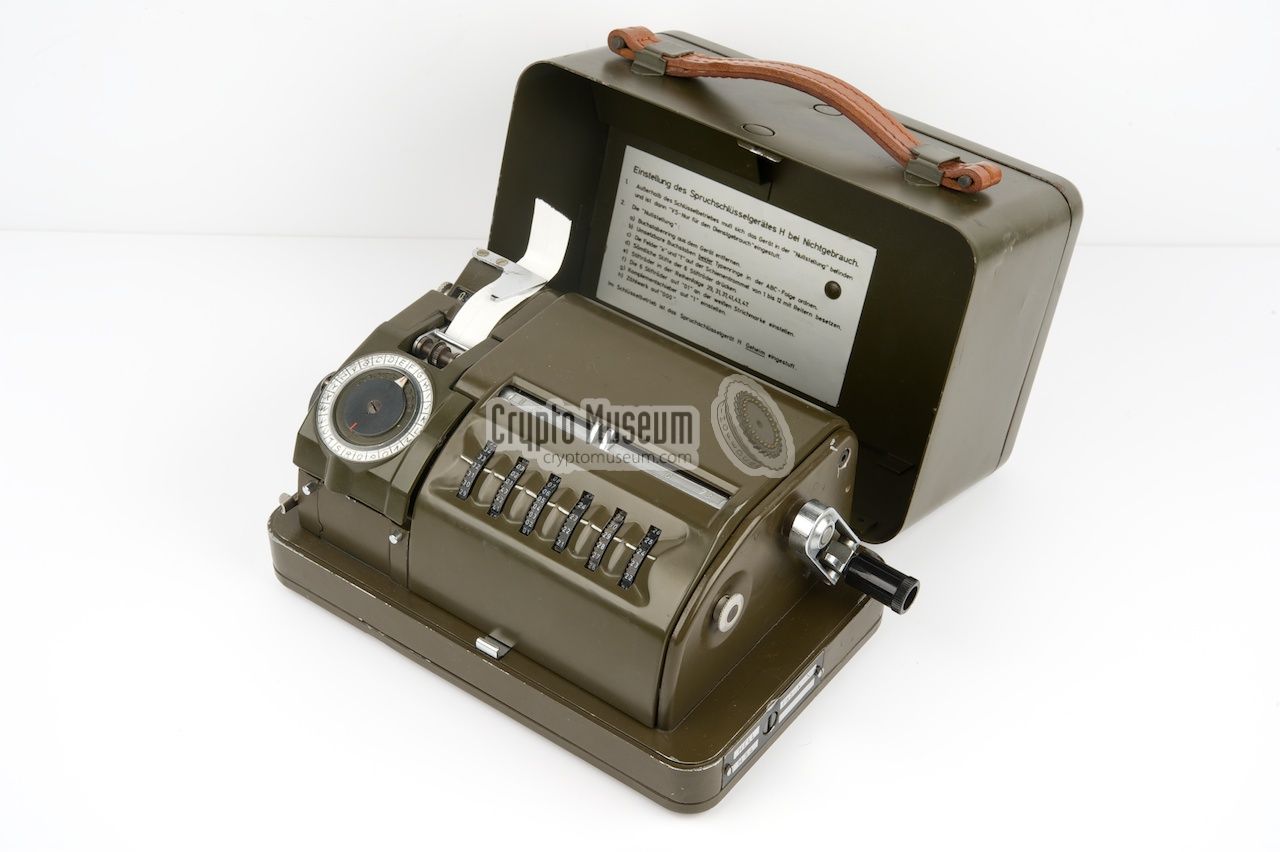
The machine is housed in a aluminum case with a metal dust cover. All metal
parts are painted in the typical Bundeswehr green colour.
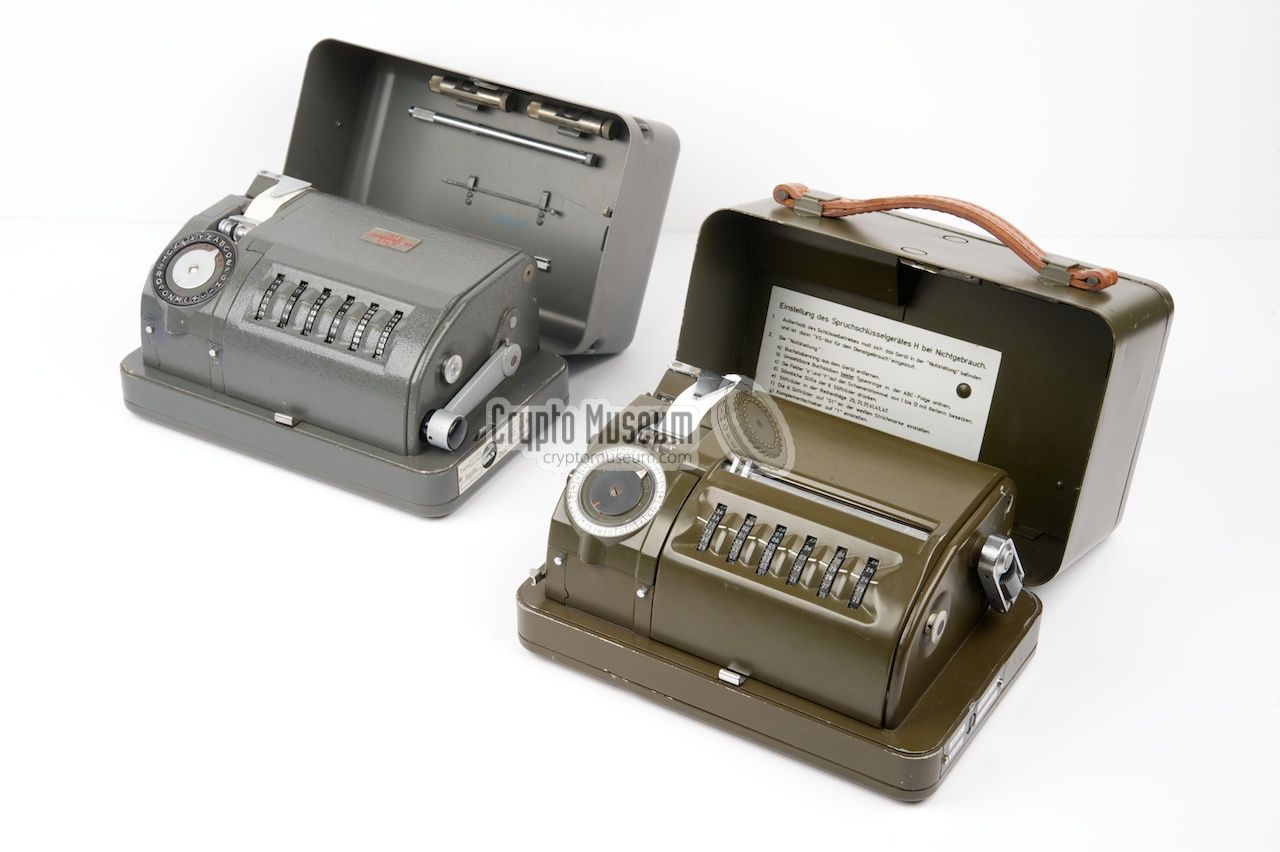
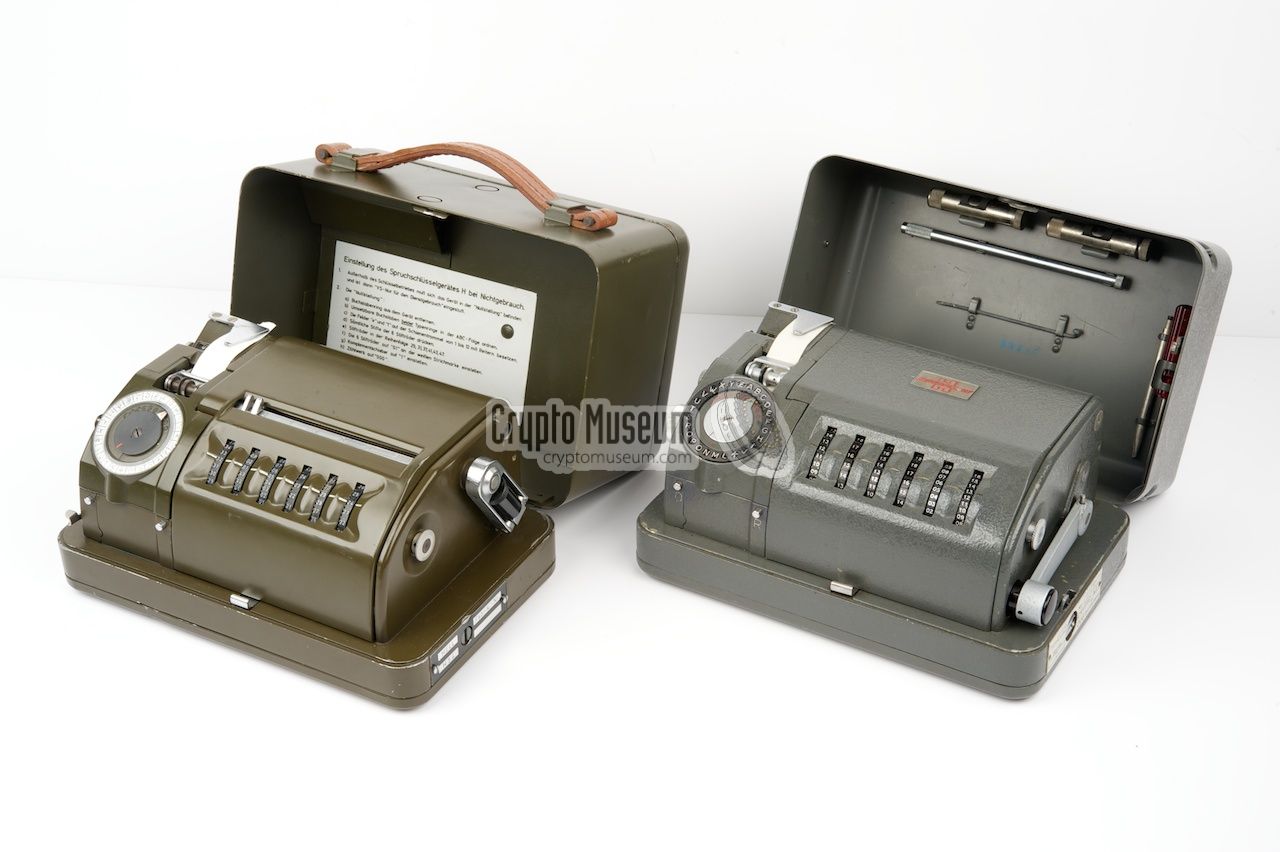
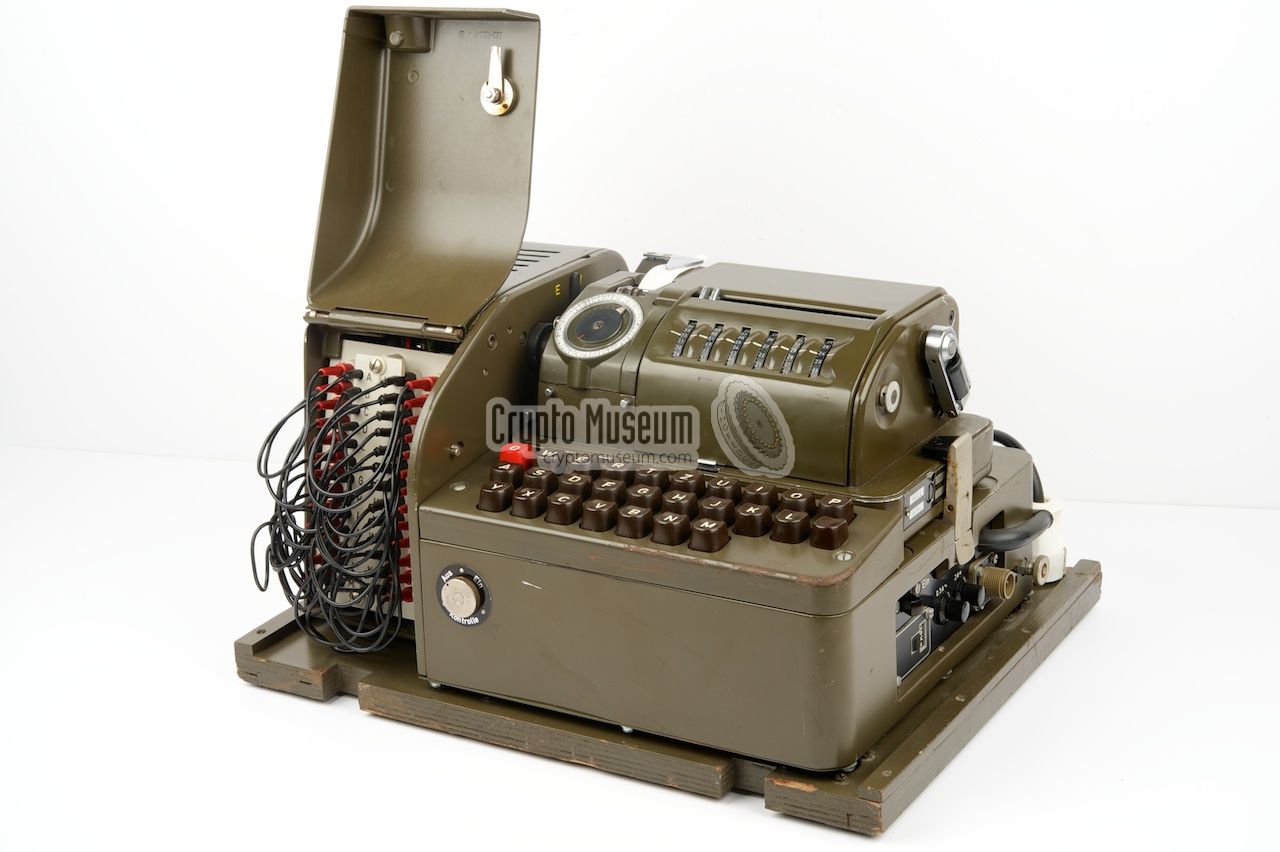
The image on the right shows a typical H-54 with its dust cover open
and the transport handle raised.
|
|
|
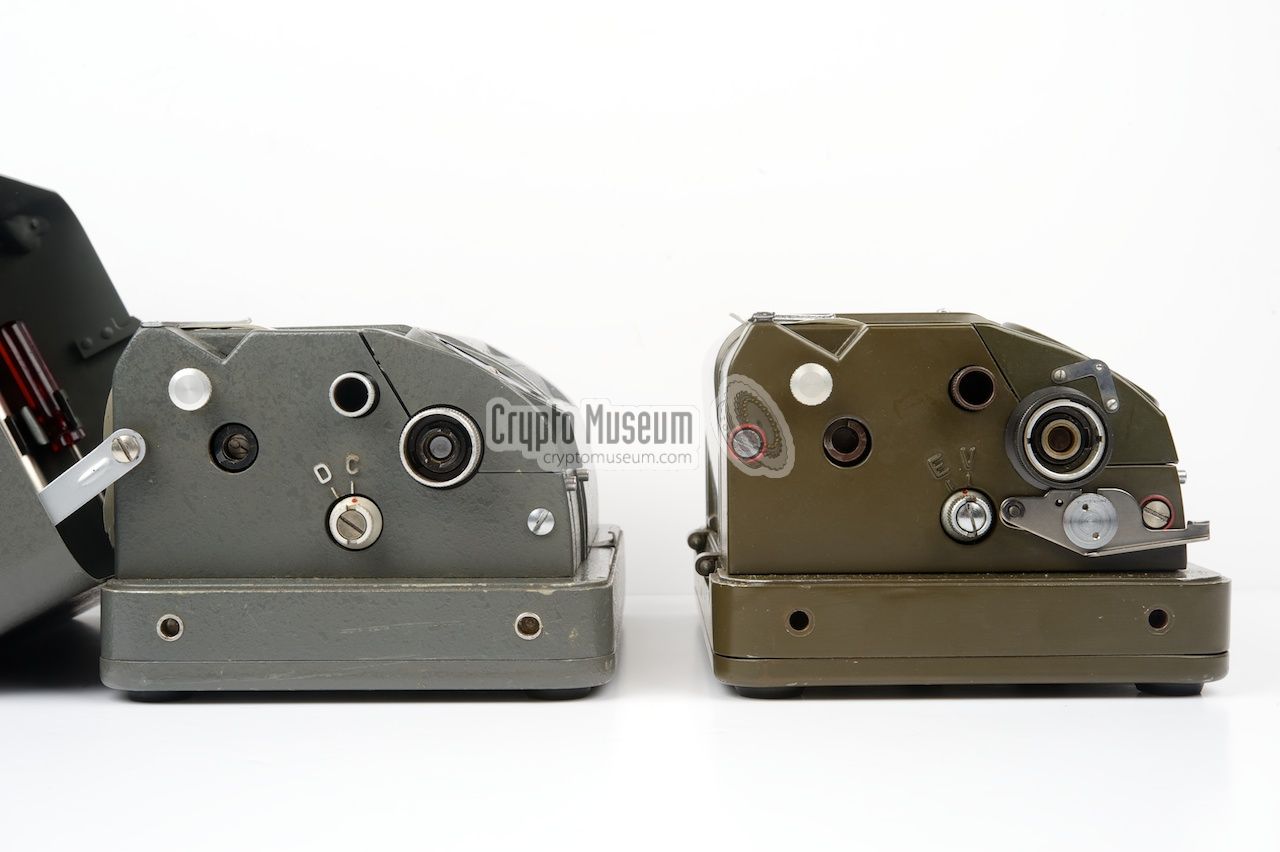
The machine was exclusively made for the German market. The various notes
and checklists are in the German language and so are the settings for
ciphering and deciphering (V/E rather than C/D).
In order to accomodate the spares and maintenance tools, HELL improved
the metal storage case and designed an ingenious
storage compartment in the top section of the dust cover.
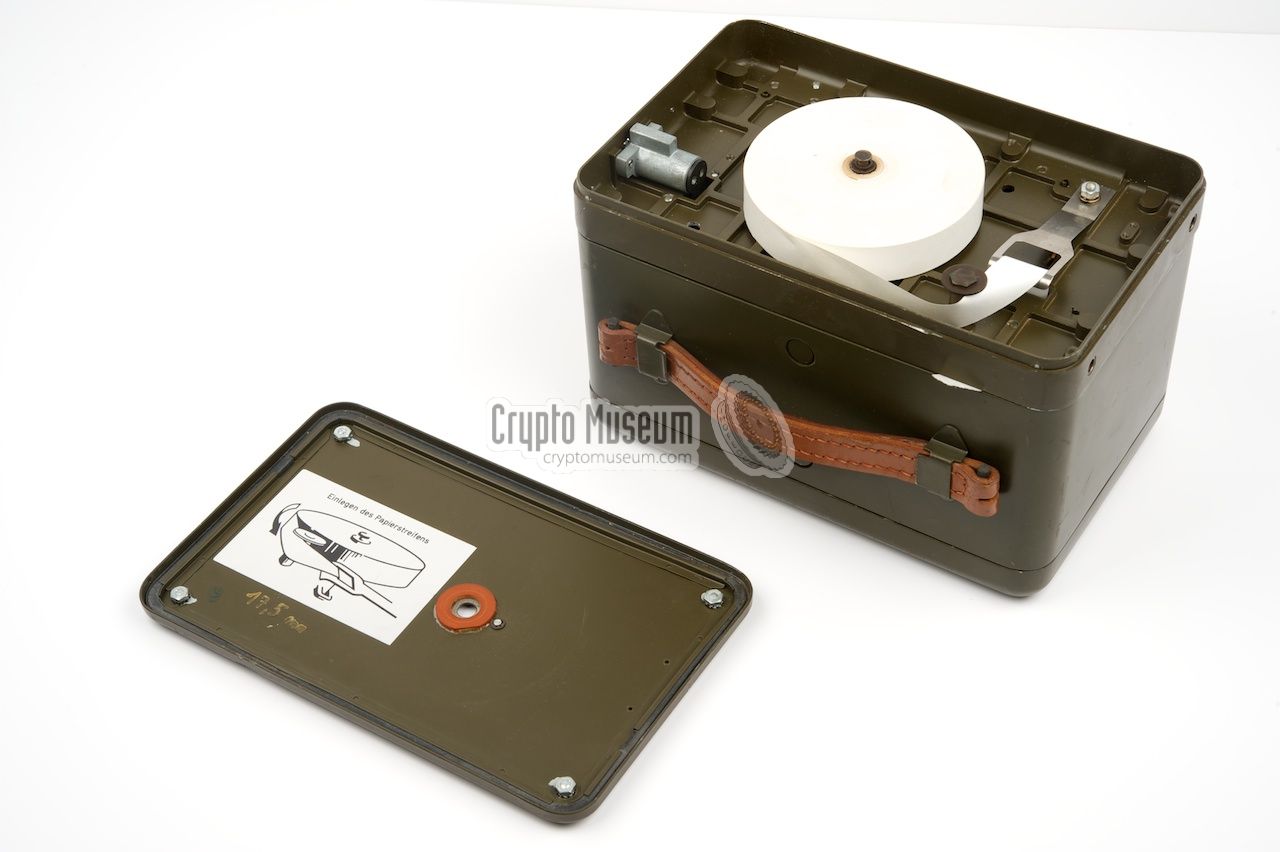
The paper reel is stored in a third compartment, at the
bottom of the machine. After removing the
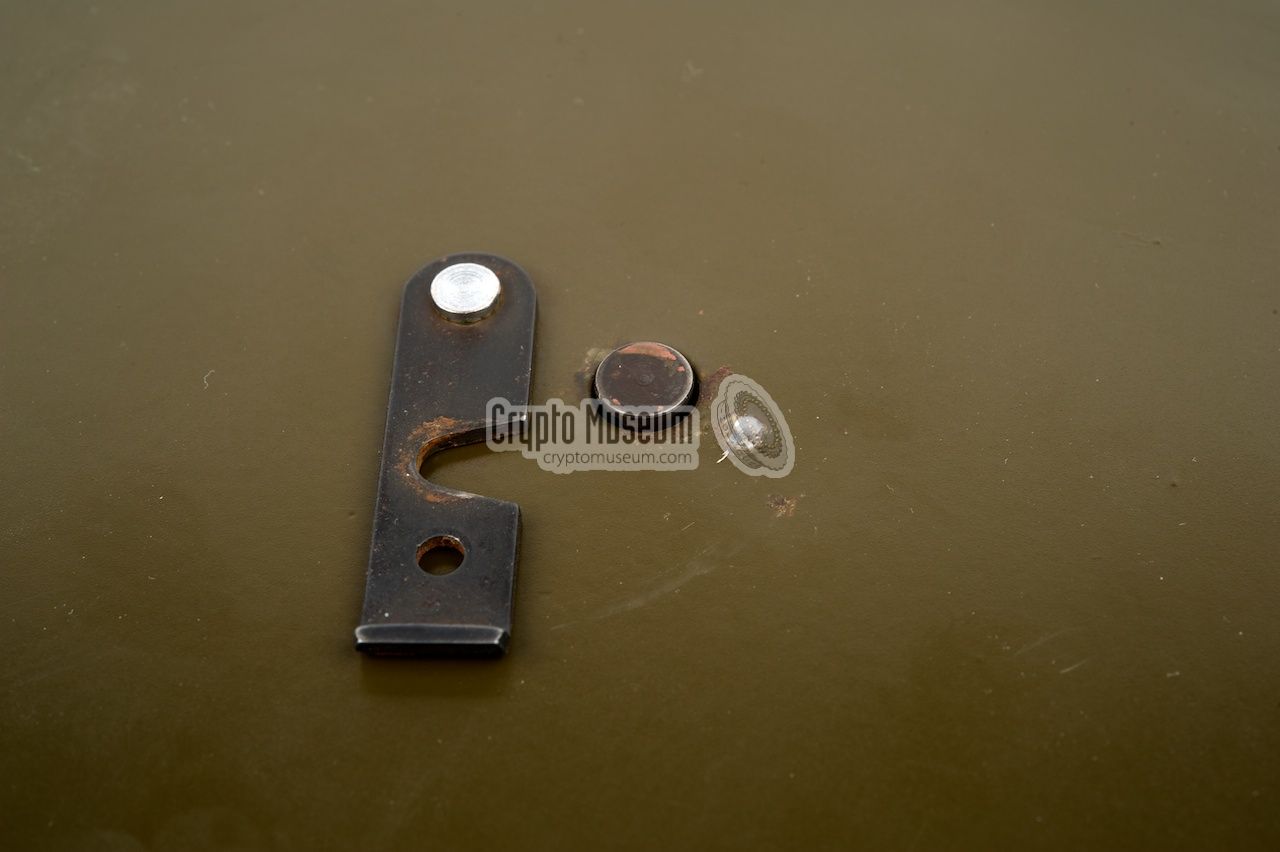
retaining clip at the center of the bottom,
the paper compartment can be opened.
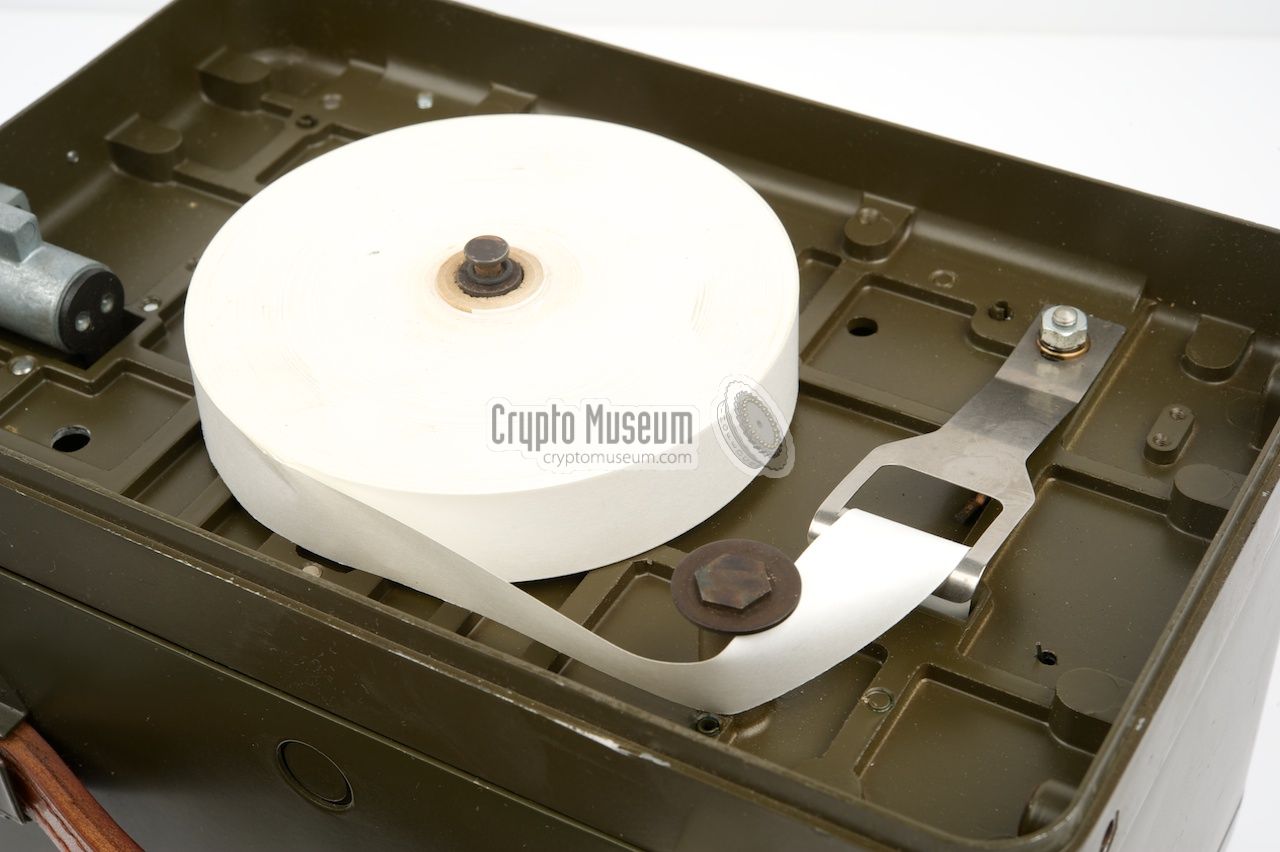
The paper tape is fed through a guide
into the bottom of the printer.
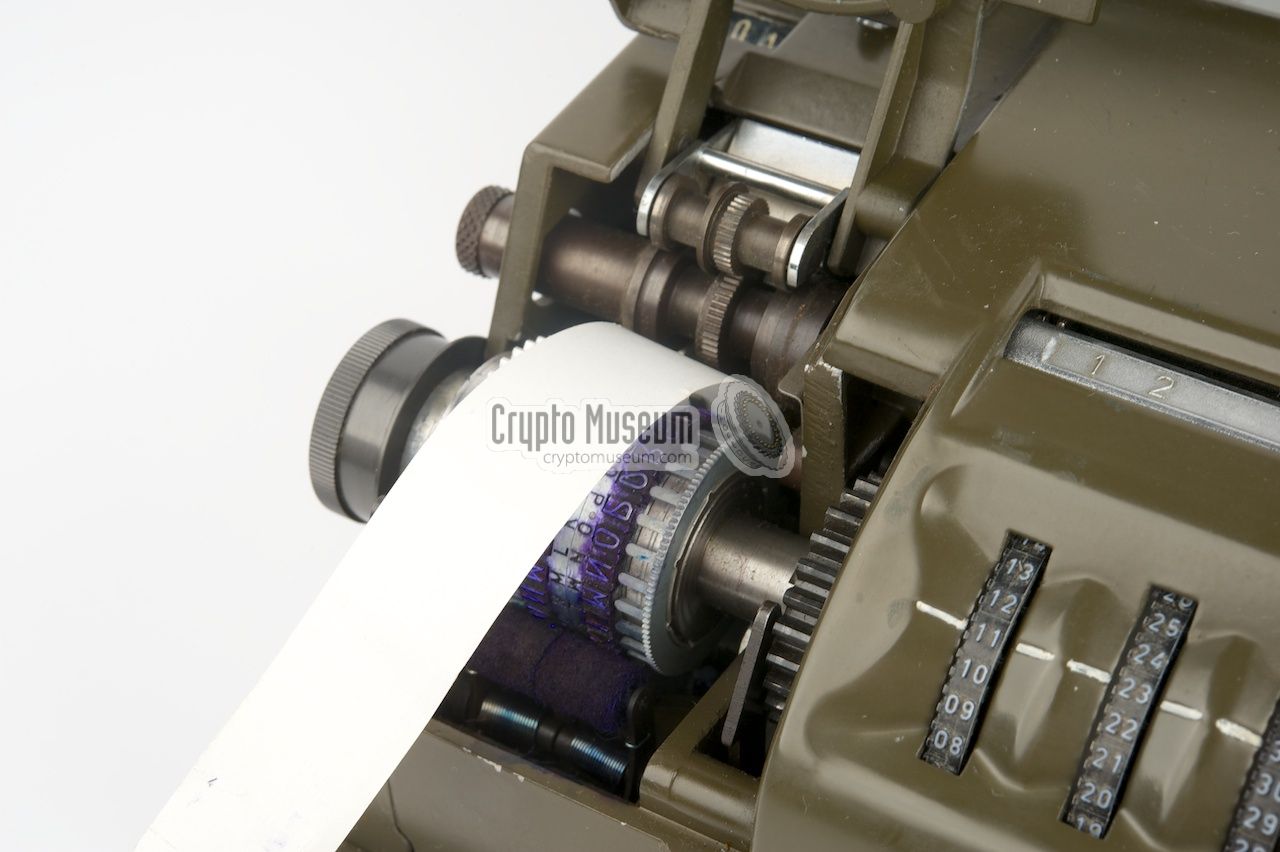
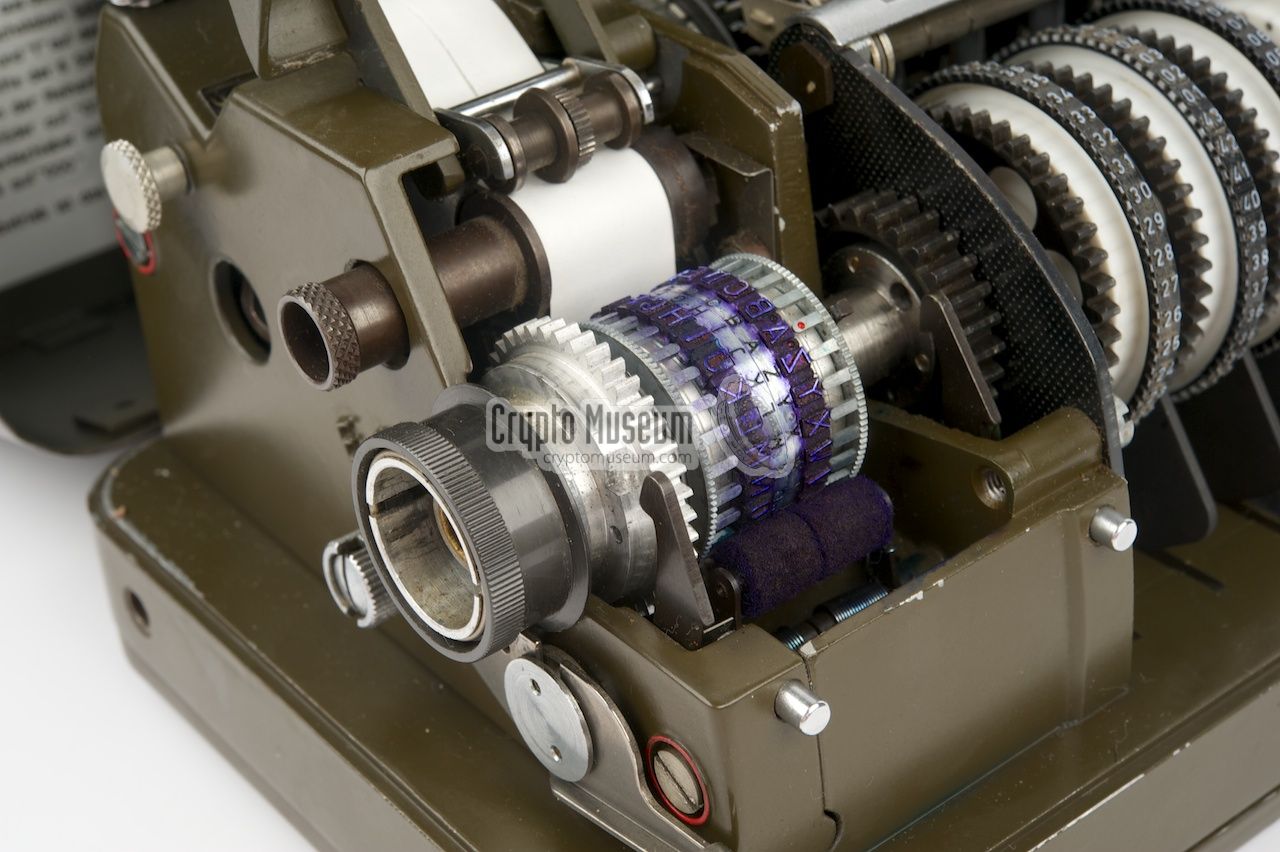
On the top side, the paper is fed behind the printhead, through
the paper feed rollers. A rotating knife
above the paper feed, slits the paper tape into two slices:
one for the plaintext and one for the ciphertext.
|
|
|
|
|
|
|
Immediately after WWII, restrictions were imposed on Germany by
the Allied Forces. As a result, Germany was not allowed to develop
cipher machines in the years following WWII. As the new German Army,
the Bundeswehr needed good cipher machines, HELL was asked to
build them under license from the
Hagelin Company in Switzerland.
Like the Hagelin CX-52,
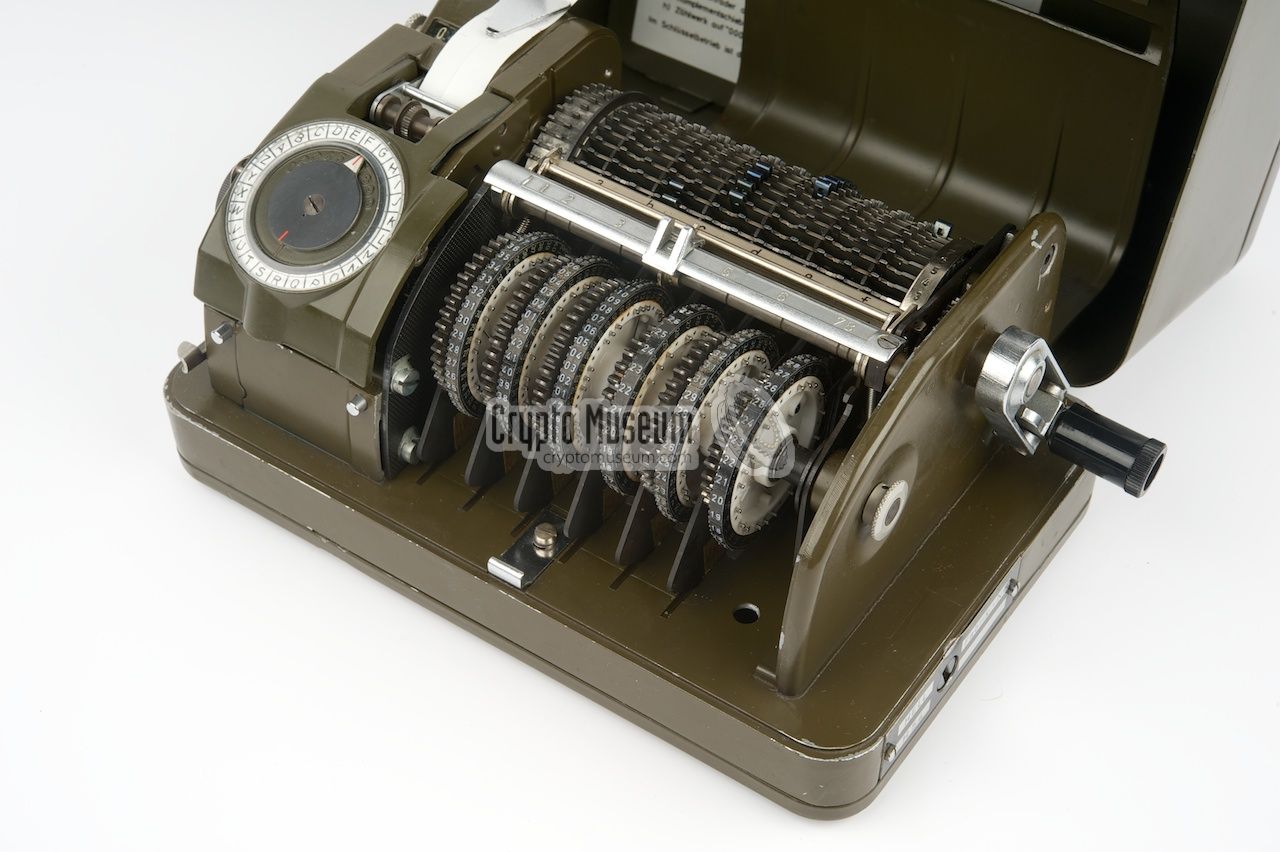
the HELL-54 is a so-called pin-and-lug machine,
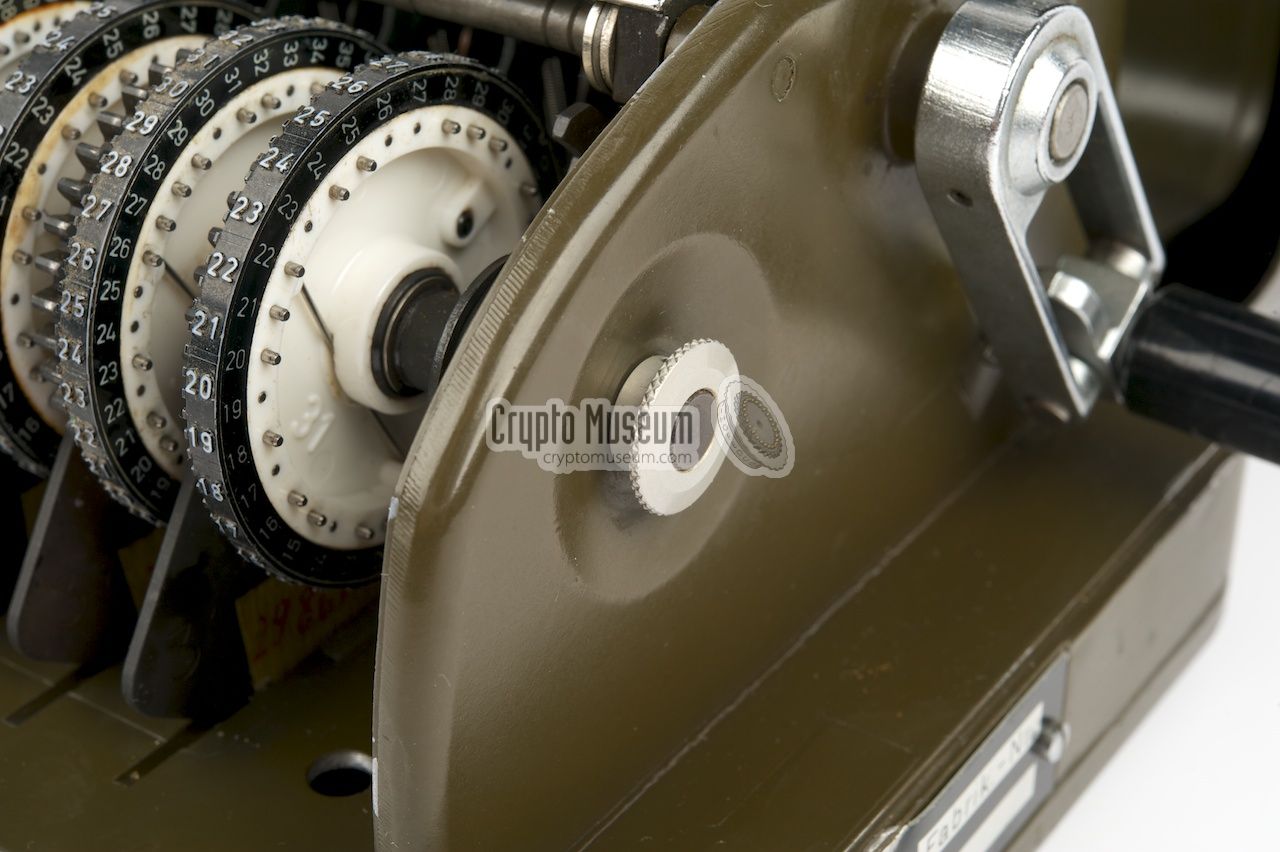
using 6 cipher (pin) wheels as its cryptographic engine. Each wheel
has a different number of steps (and hence pins) to complete a full
revolution, all of which are co-primes in order to obtain the maximum
possible cryptographic period. Each wheel carries a number that corresponds
to the number of steps. Unlike the CX-52, that was supplied with
12 different cipher wheels, the H-54 came with a selection of
just six of these wheels, with the following number of steps:
29 31 37 41 43 47
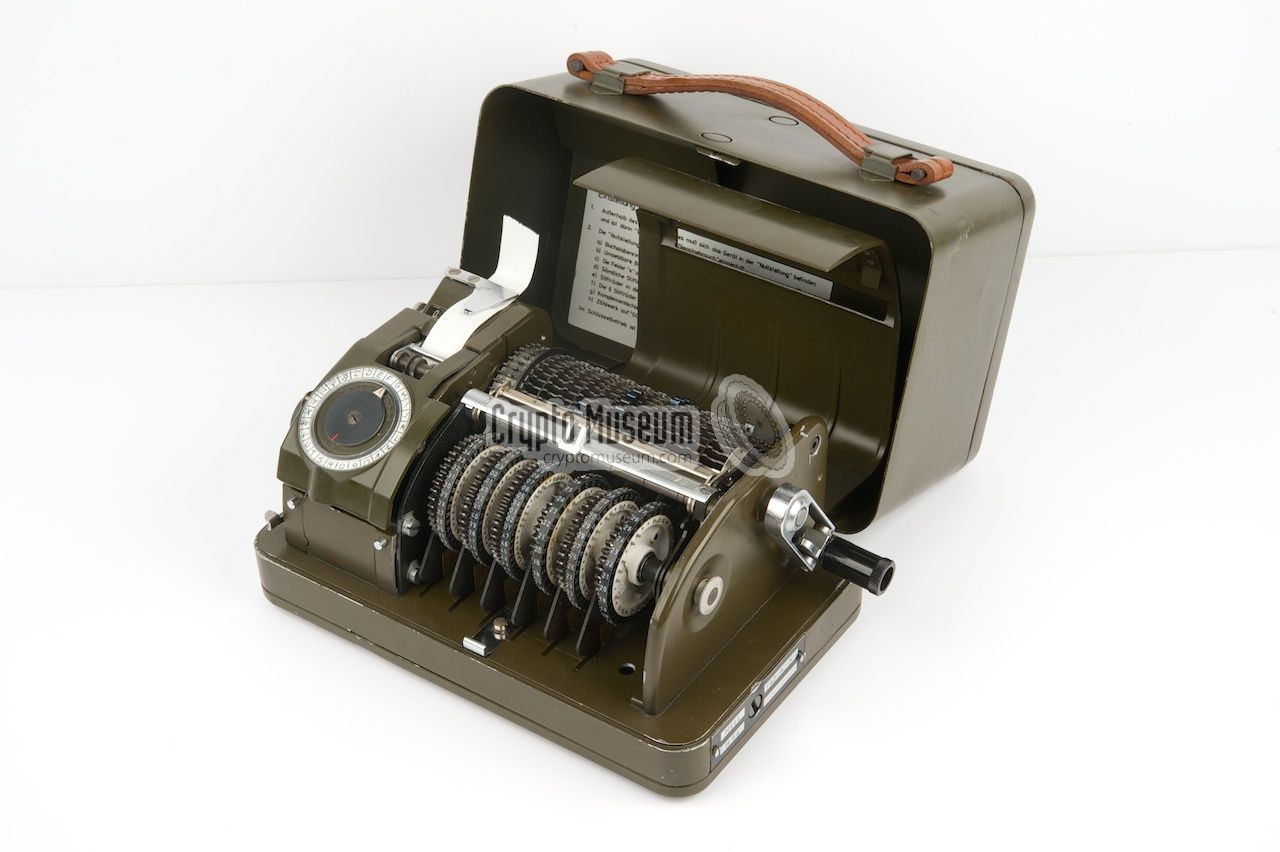
Each of the six wheels is mounted on a metal base plate with a cog-wheel
and the corresponding number engraved. The wheels should only be mounted
on the matching base plates. The base plates can be removed from the
machine by pulling out the
main axle from the right. They can then be
inserted again in 120 different orders (6 x 5 x 4).
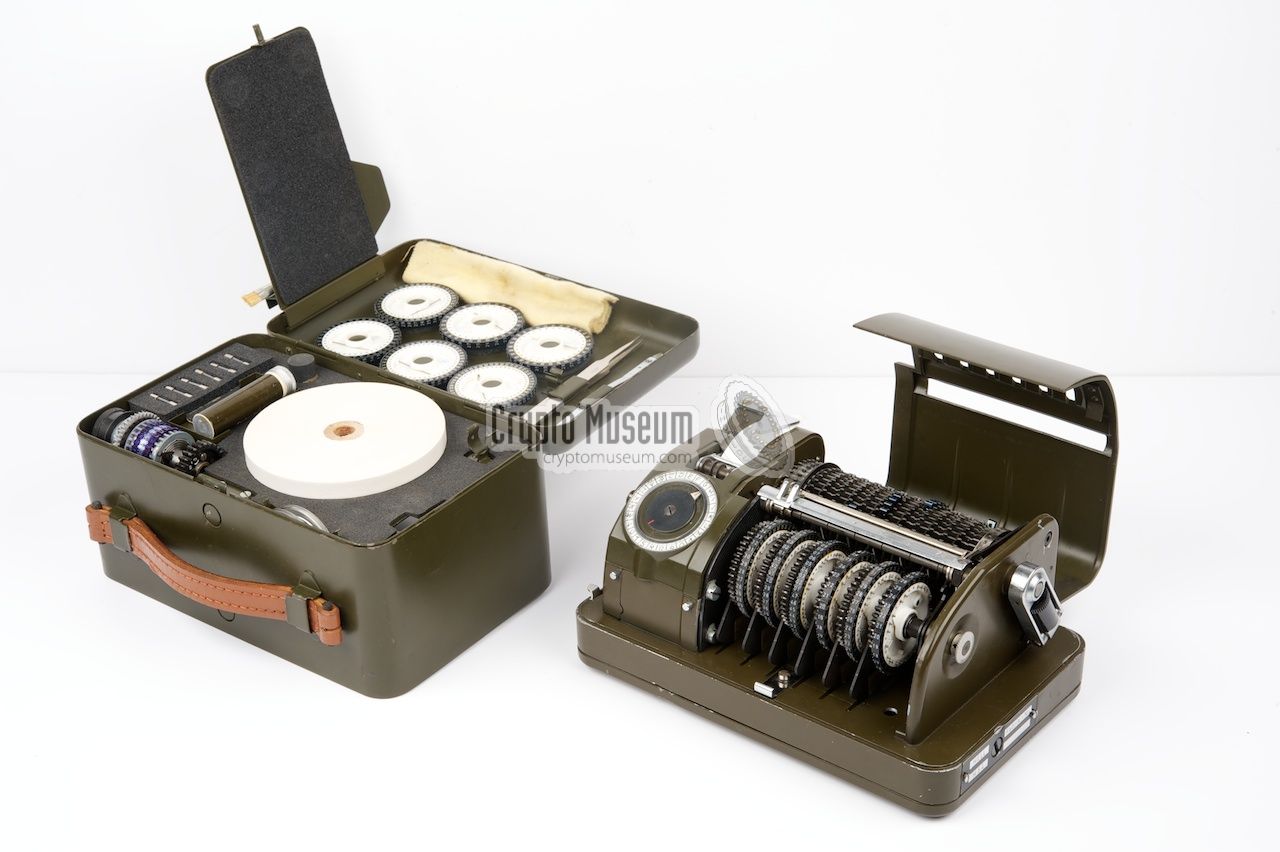
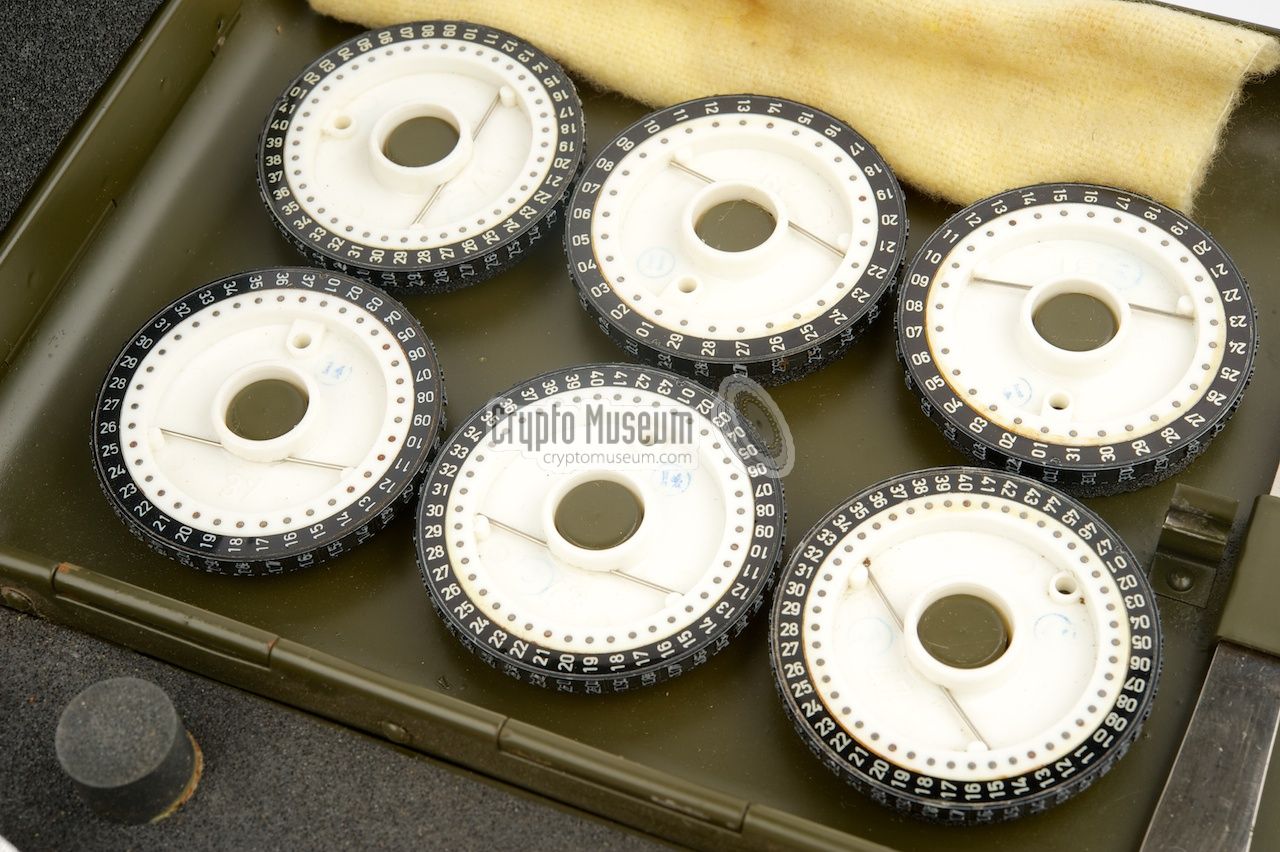
The toolbox of the machine contains
six spare pin wheels with the same
number of steps as listed above. This allowed a new set of pin wheels to
be prepaired for next day's cryptographic key well in advance. When the
key was changed at midnight, there would be a minimum down-time.
The machine was interoperable with the Hagelin CX-52, but only if the
six cipher wheels listed above were used. The CX-52 was sometimes with
12 different cipher wheels, of which only these six matched the H-54.
The handheld HELL STG-61 was supplied with the
same wheelset.
|
|
|
Improvements over the CX-52
|
 |
|
|
The H-54 was built under license from the
Hagelin Company in Zug (Switzerland)
and was functionally identical to the
Hagelin CX-52. Nevertheless, the H-54
has some practical improvements over the CX-52 design.
The most important ones are listed here:
|
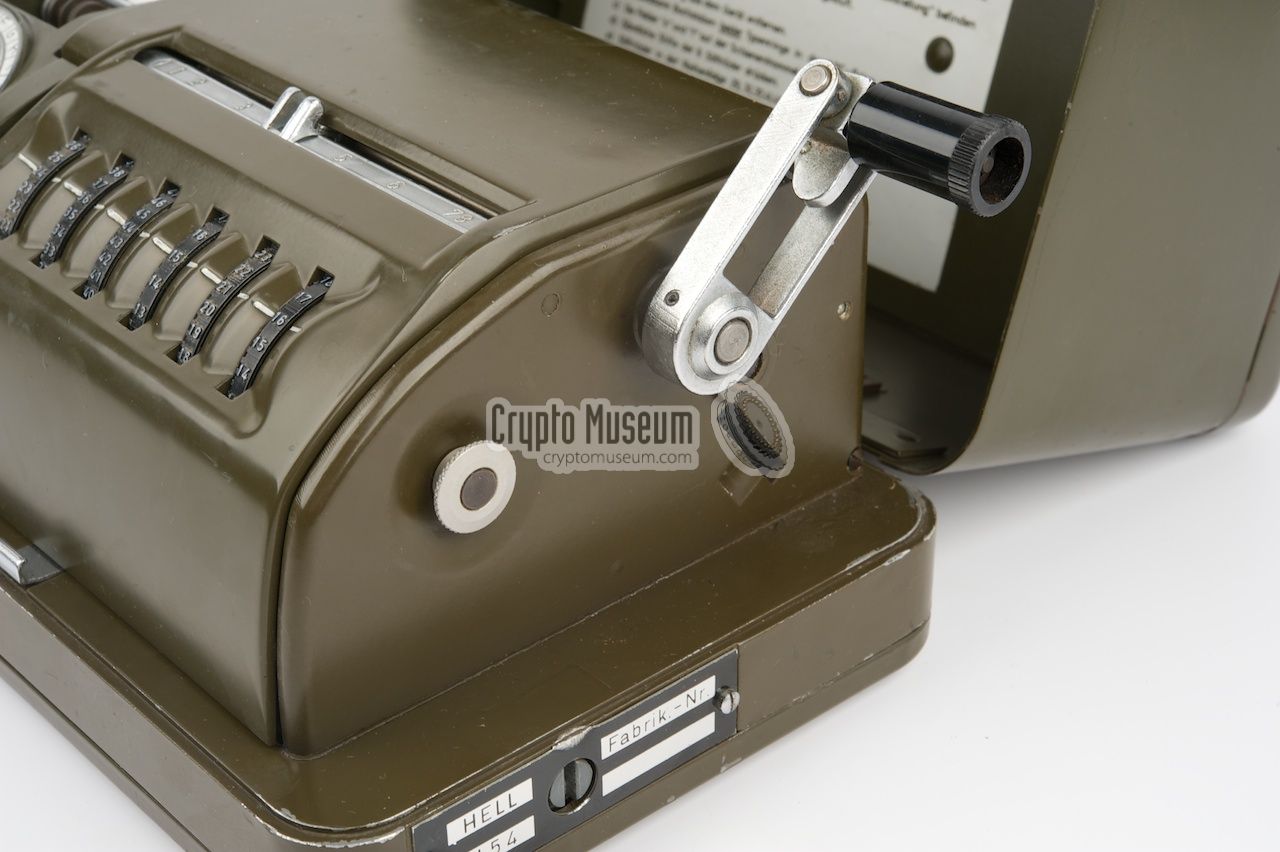
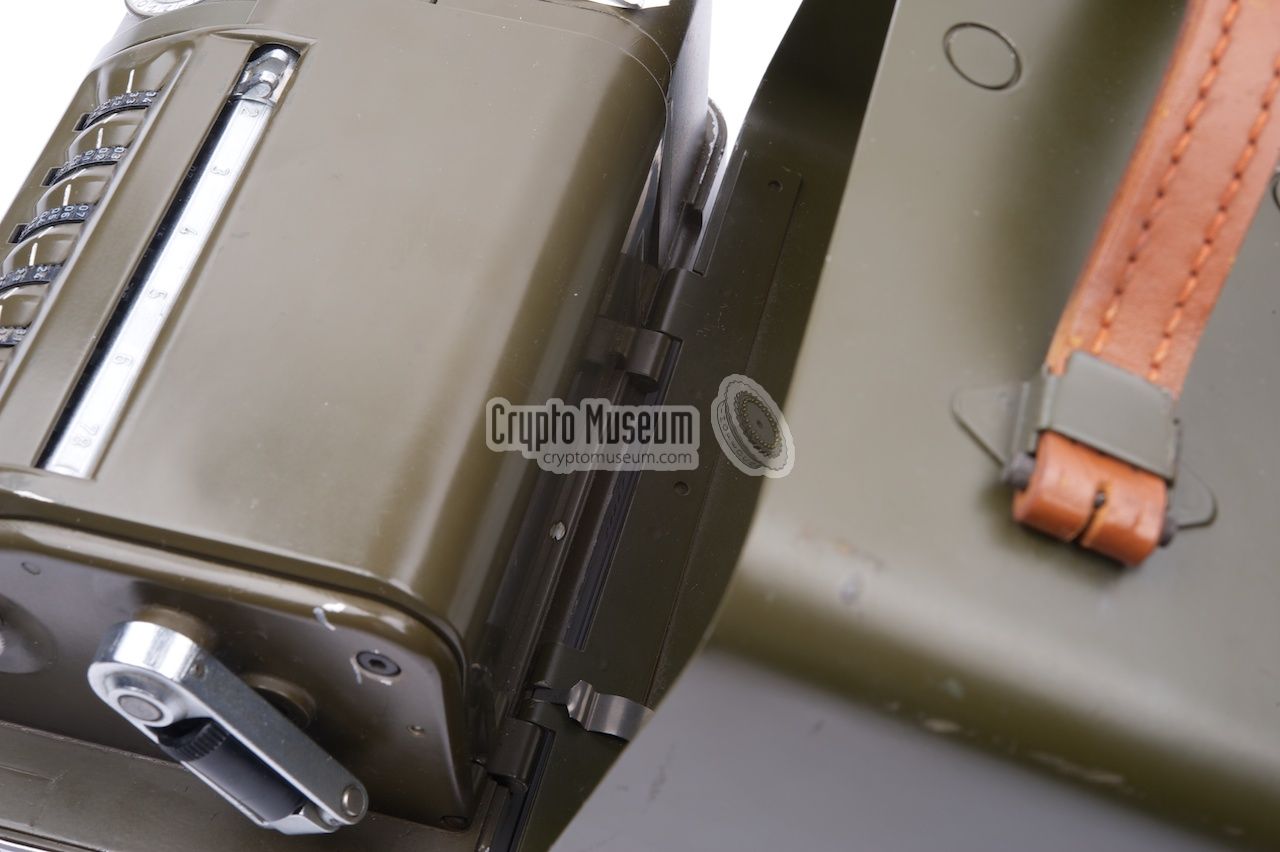
- Transport handle
The transport handle at the right is more robust
and is in a different position.
Furthermore, it makes full revolutions, whereas the handle of
the CX-52 only makes an up/down movement.
The handle can be rotated backwards freely without affecting the
mechanism. The (black) knob of the handle can be folded 'inside' the
handle, only when the handle it locked in its storage position.
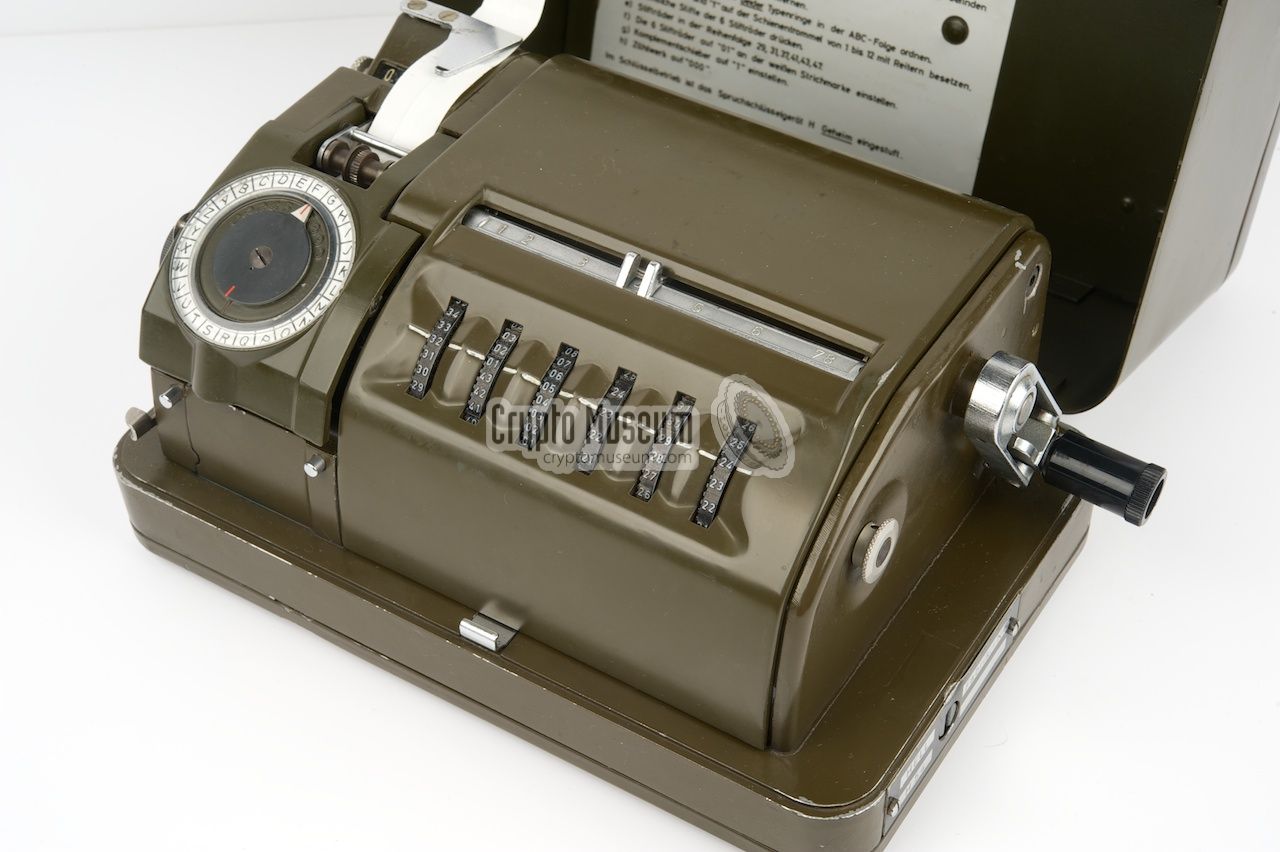
- Complementary slider
Above the cipher wheels is a narrow window
with a ruler (marked 1 to 8).
Behind this window is a movable tab that can be clicked into any of the
8 positions.
- Robust housing
the outer body of the cipher machine and the
top lid that covers the wheels,
are made of slightly thicker aluminium, making the machine more robust
in day-to-day military use.
- Improved case
The storage cased is improved over the original Hagelin design. It now
contains an extra storage compartment
in the top section of the lid,
whilst in the original design, some tools were stored inside the top lid.
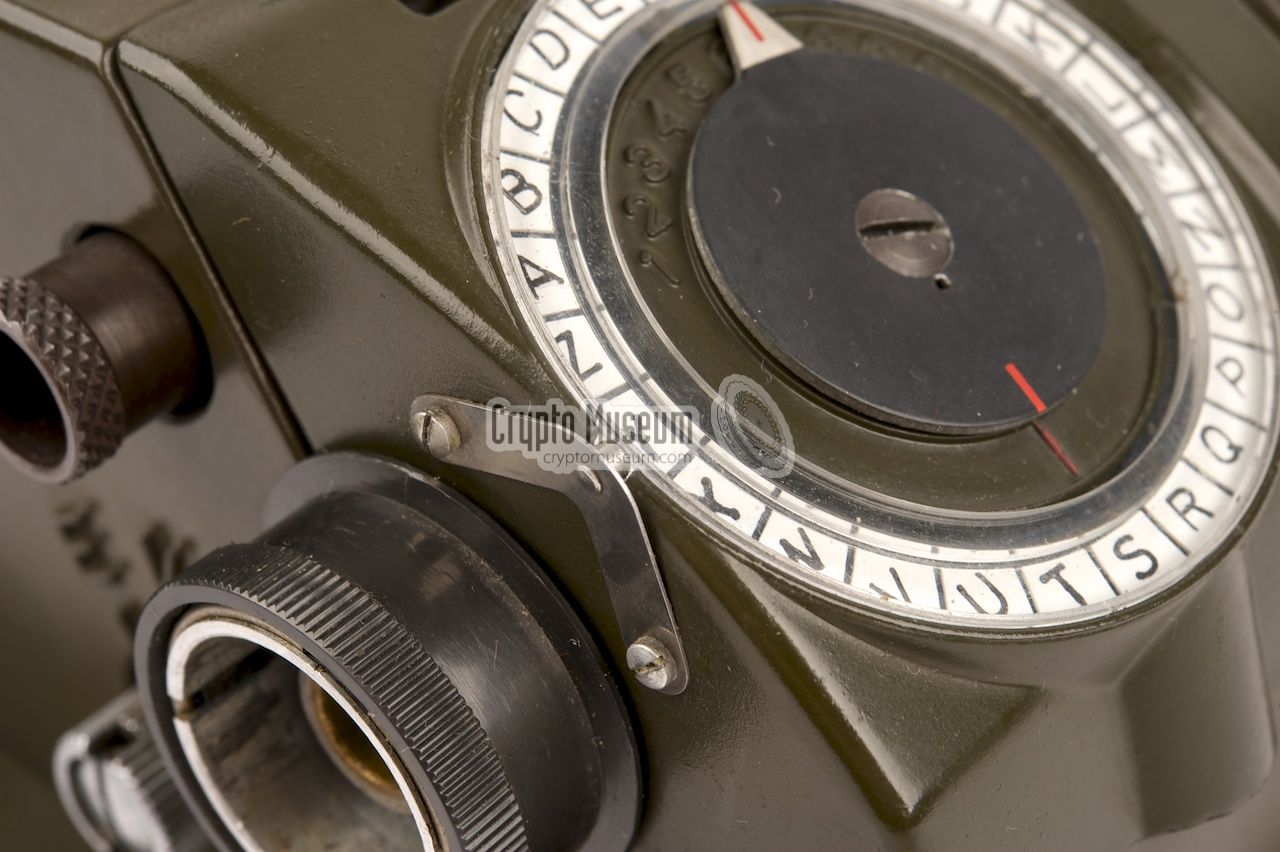
- Removable alphabet ring
The alphabet ring at the front left
can easily be swapped for an alternatively
ordered alphabet by removing the plastic ring. The ring is held in place by
means of a small piece of feathering steel at the left.
On the original CX-52, the letter ring consisted of separate letter-inserts
that had to be placed/swapped individually.
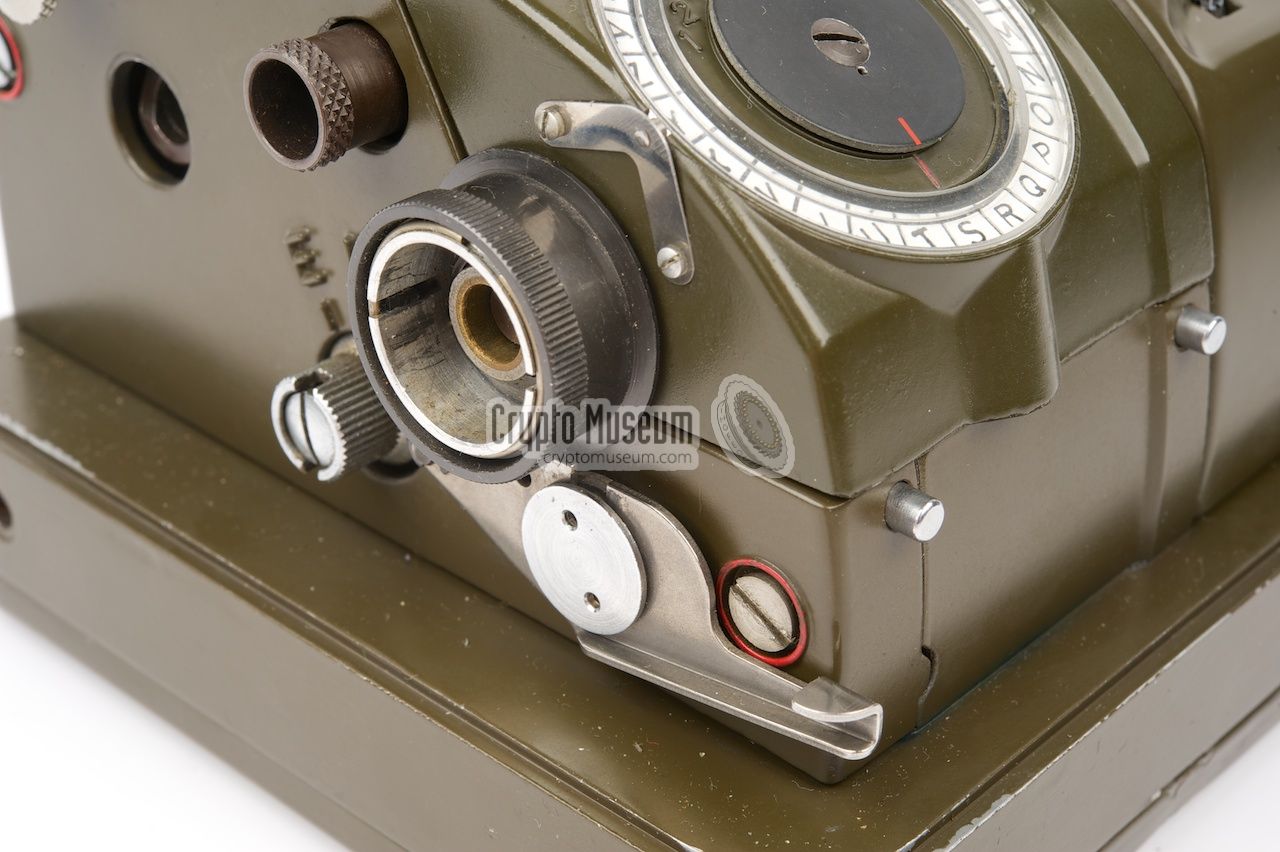
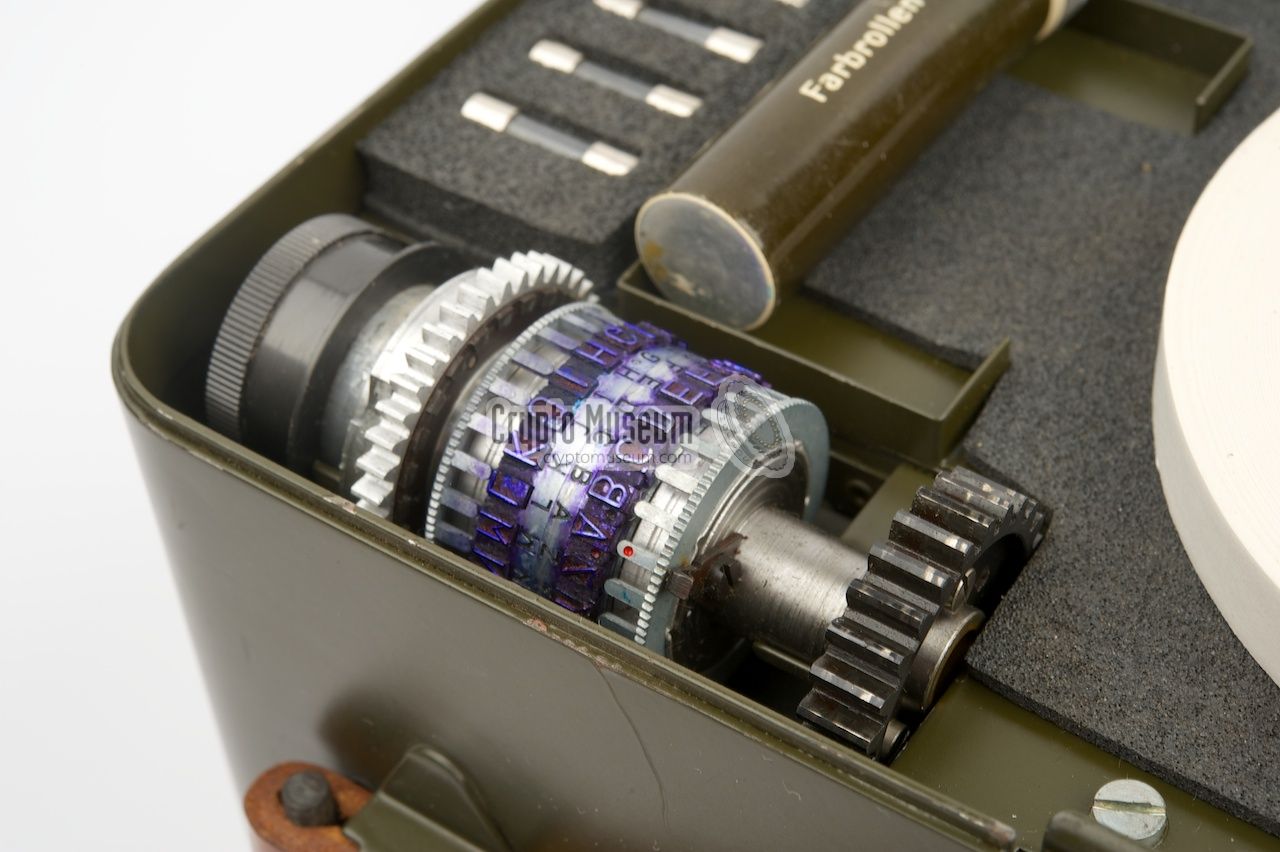
- Print wheel retaining clip
By pulling the print wheel knob at the left side
of the machine, the offset between the two print heads
(i.e. the offset between the input
and the output alphabet) can be adjusted. To prevent this from happening
accidently, the knob of the H-54 has been given a plastic rig that is
blocked by a retaining lever mounted below it. In order to adjust the
alphabet offset, the lever should be pushed down before pulling-out the
knob.
- Removable dust cover
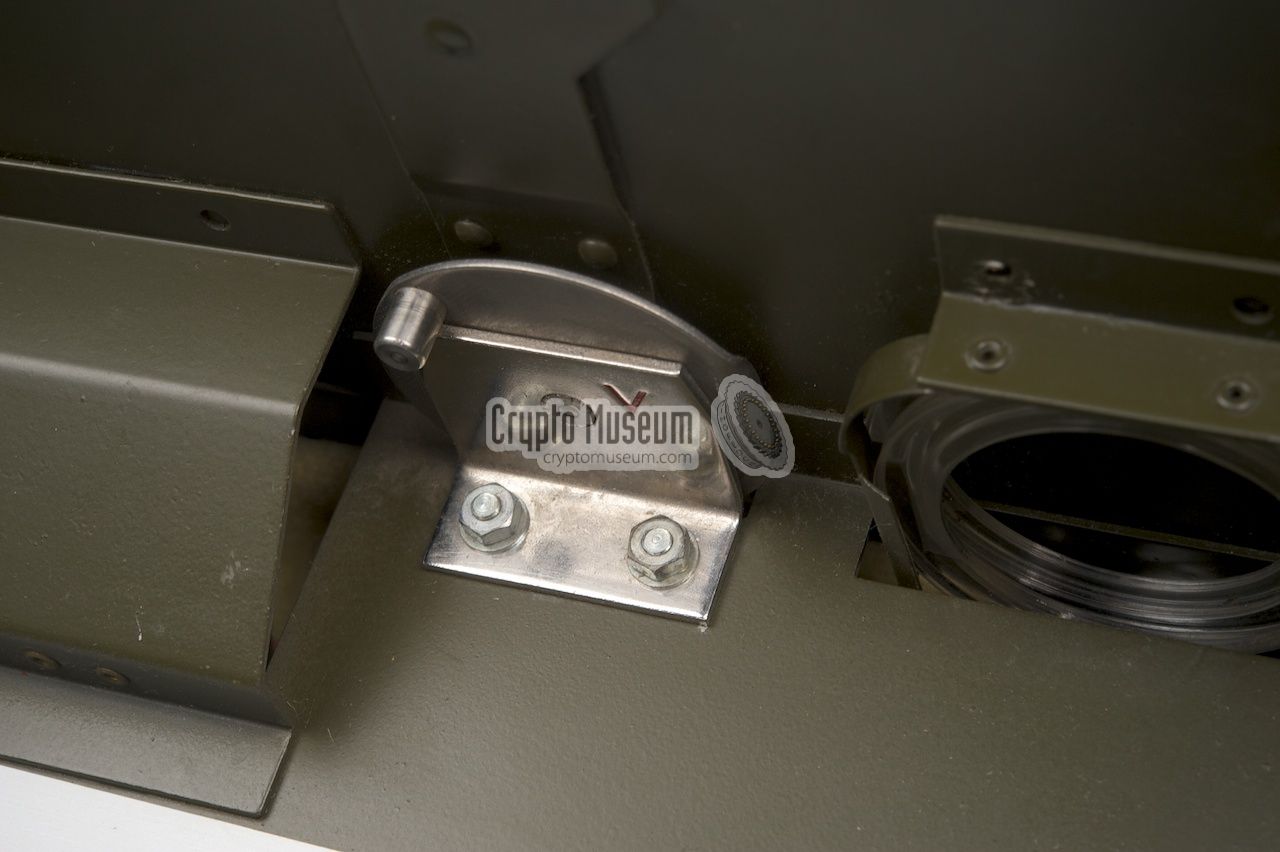
In order to mount the H-54 on the B-62 keyboard, the dust cover
(i.e. the toolbox) might have to be removed from the machine. On the original
CX-52 this was done by unscrewing the rear hinge of the cover. On the
H-54 however, a slide-on cover has been used.
It is held in place by means of a simple retaining clip behind the machine.
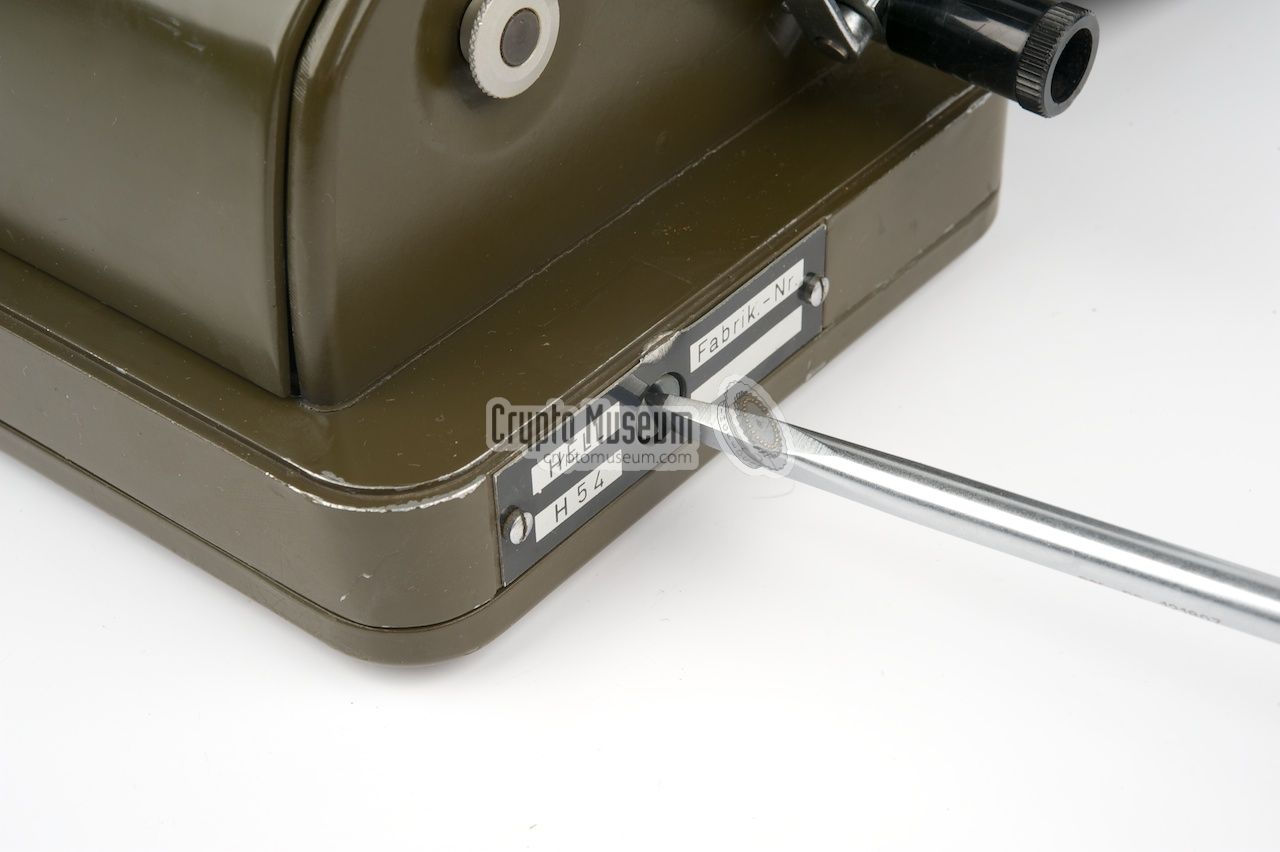
- Simplified case lock
The original CX-52 was issued with either a cylinder lock or a complex
cross lock at the right side. The case could only be opened with the
appropriate key, whilst the cover over the wheels was locked with an
even more secret key.
On the H-54 only simple locks are used, as the
machine was considered to be issued only to qualified personnel. The
lock at the right has been replaced by a simple one that can be operated
with a screwdriver.
|
|
|
|
|
|
|
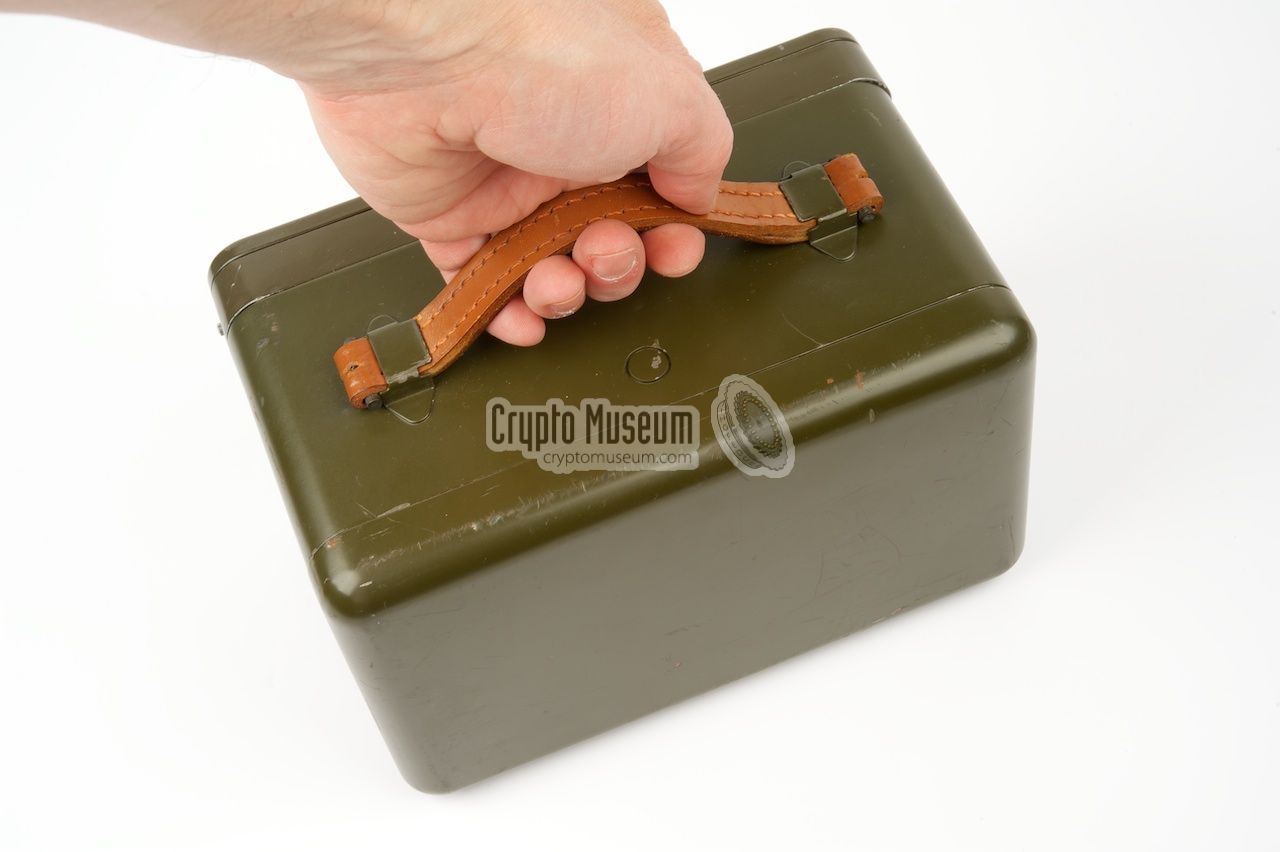
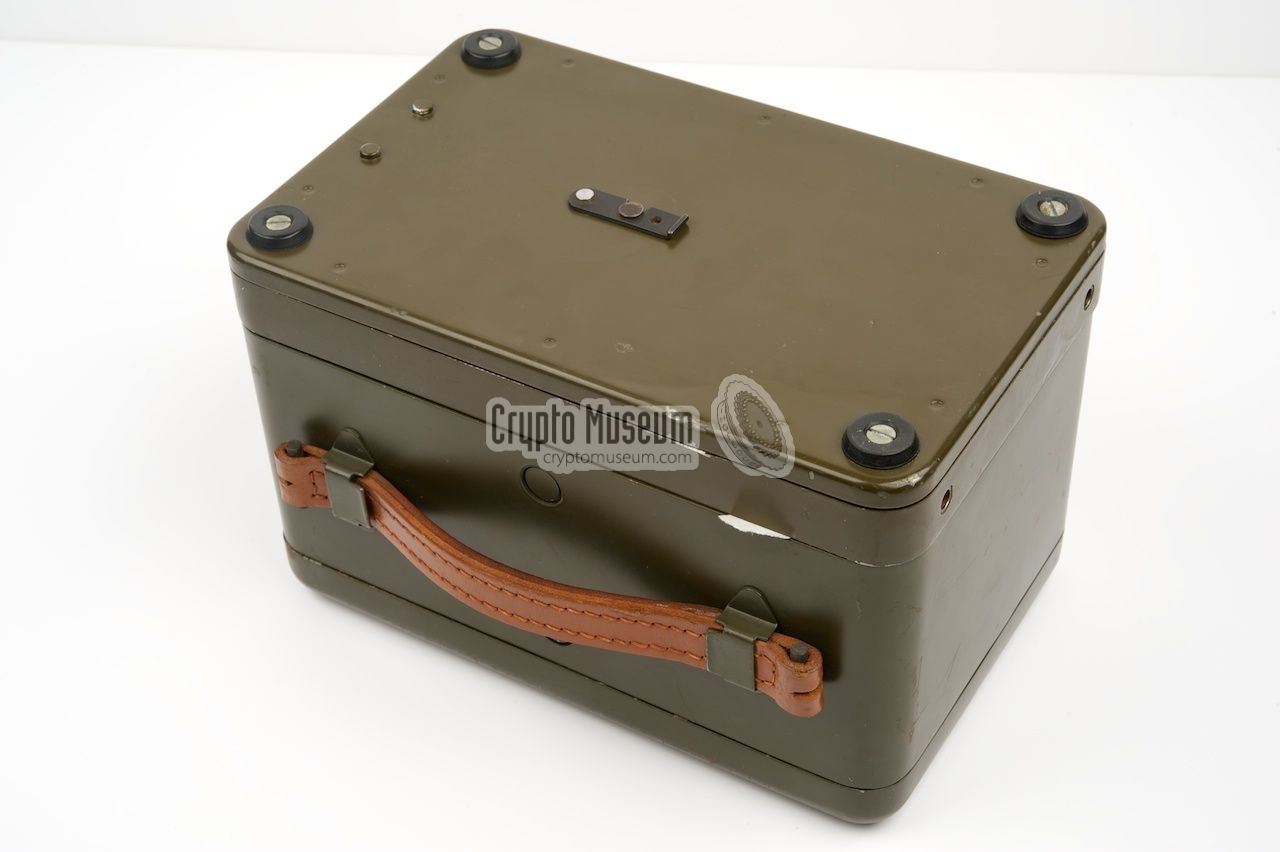
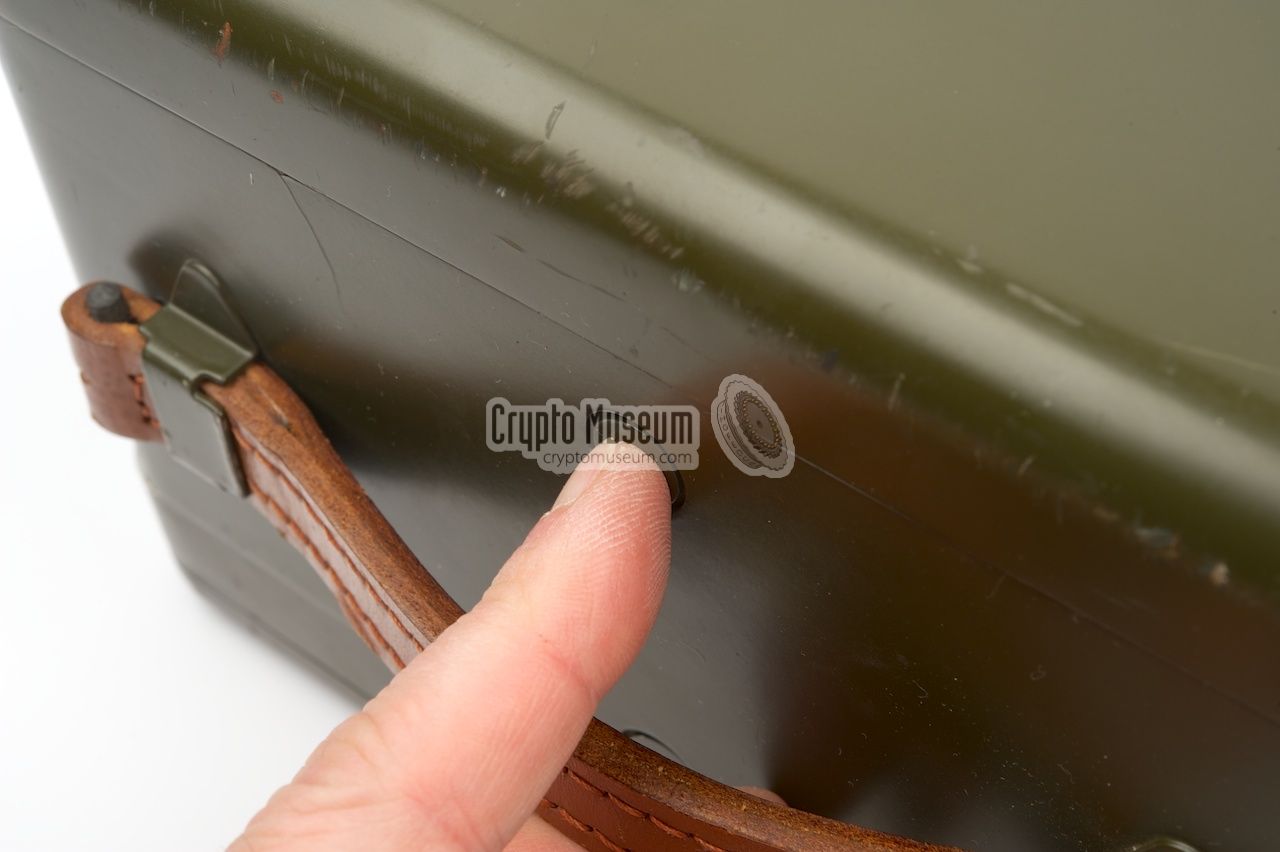
One of the nicest improvements of the H-54 over the original
Hagelin CX-52 is the addition of
a clever storage compartment in the top section of the dust cover.
An extra lock, just above the leather carrying strap gives access to this
compartment. Press the knob to open the top lid.
If it doesn't open, you may have to disengage the
safety lock
inside the dust cover first.
|
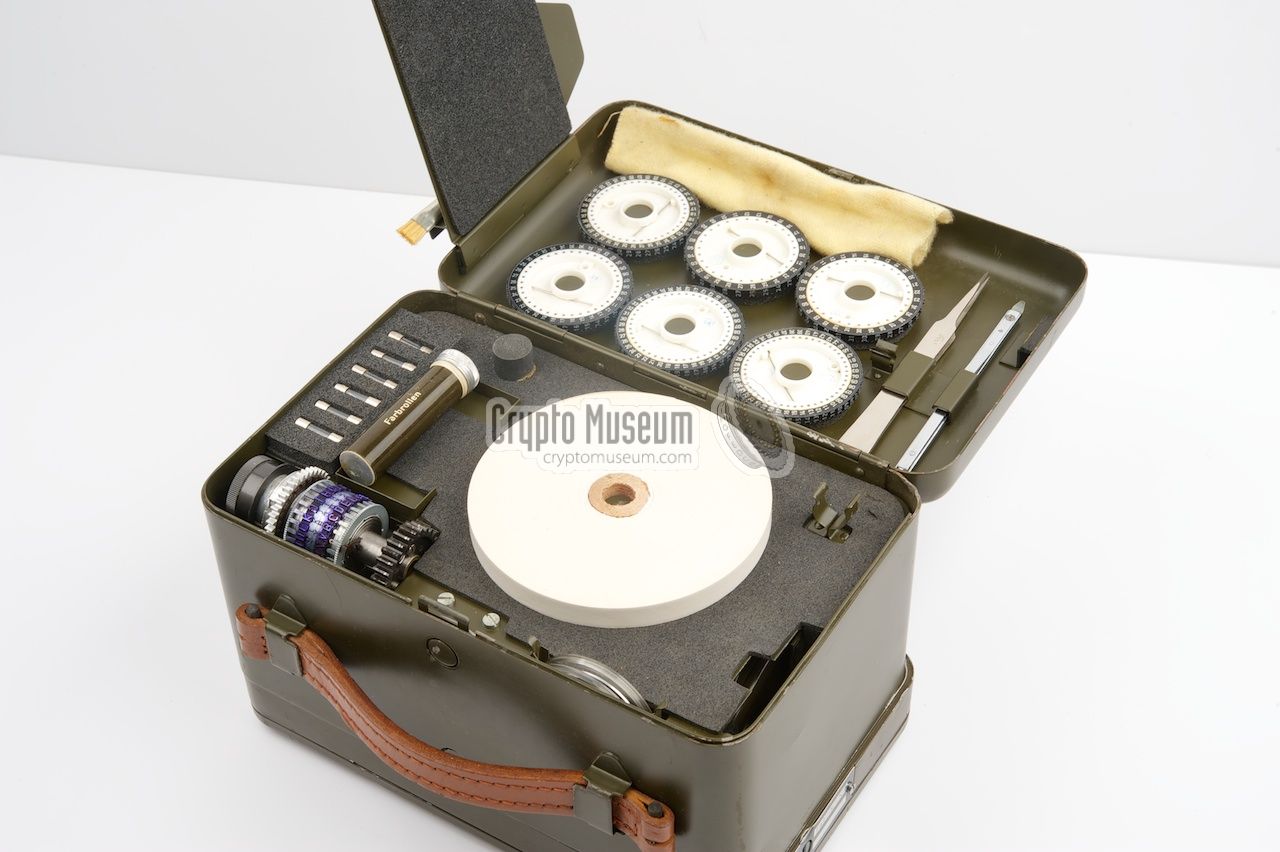
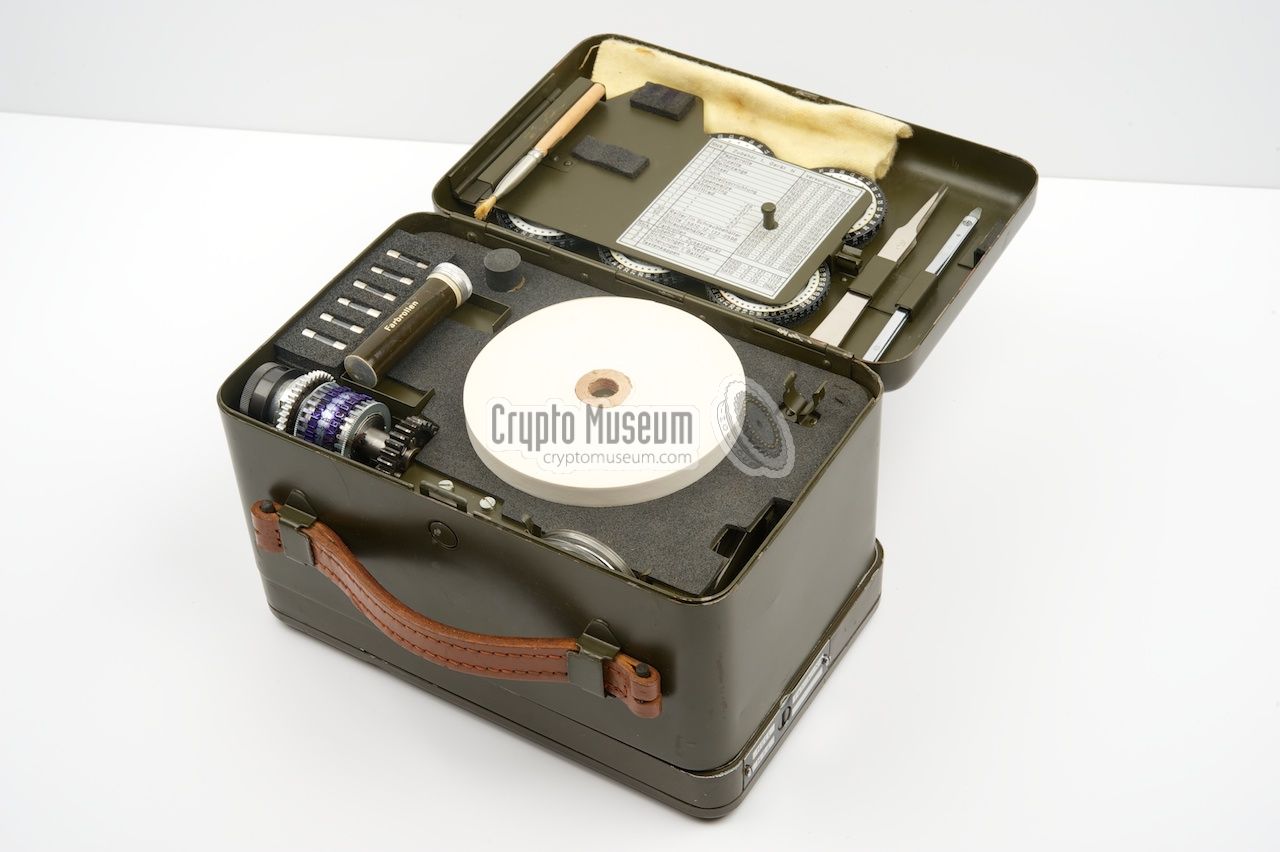
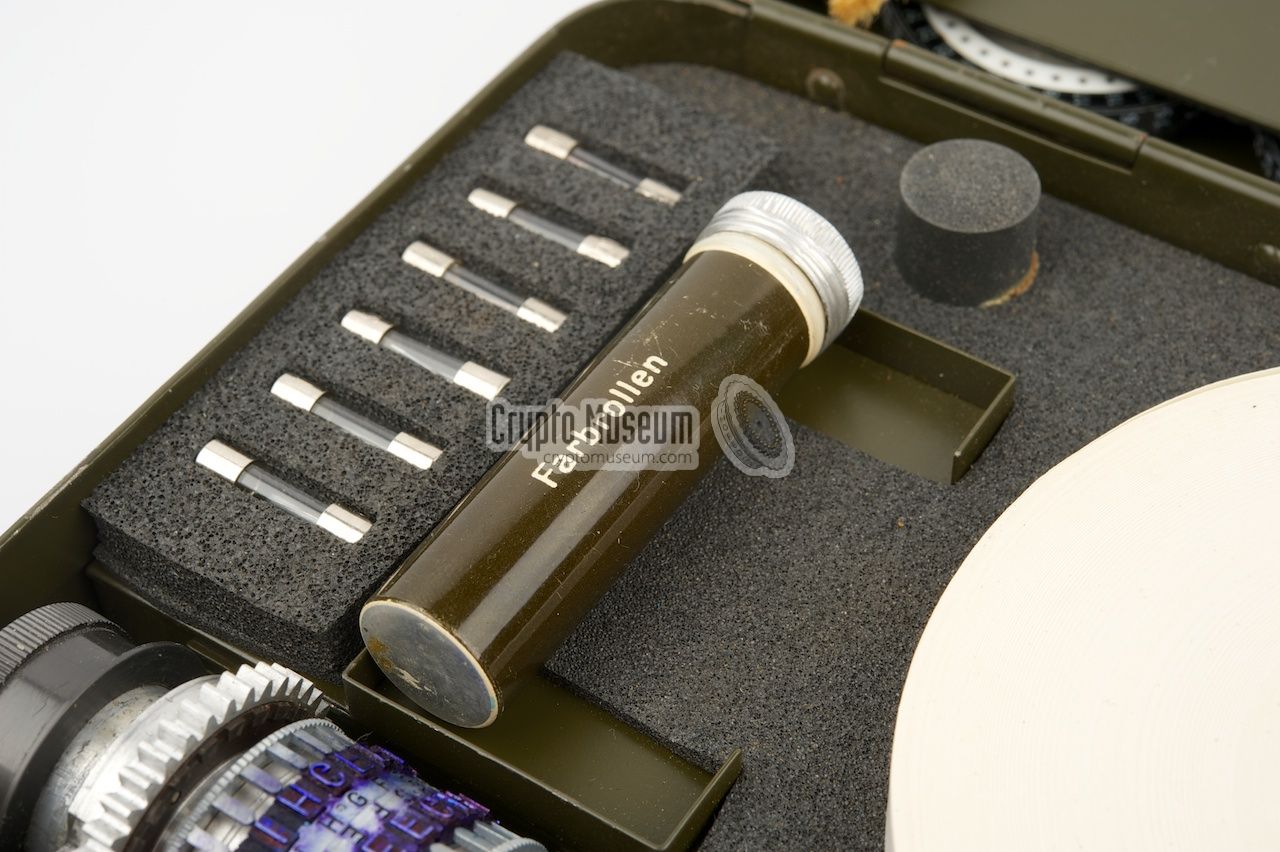
The image on the right shows the H-54 cipher machine with its dust cover
closed and its toolbox open. Some parts are stored on top of the machine,
whilst the remaining parts are stored inside the case lid. A checklist
(in the German language) inside the top lid shows which parts and
accessories should be present.
The lower part contains a spare paper reel at the center. To its left
are two cylinders:
one with spare ink rollers and another one with spare
pins (missing here). At the far left are
6 spare fuses (300 mA and 2A)
for the B-62 keyboard.
|
|
|
At the front left is a spare print wheel (missing from our set) and at the
far right is a pin-wheel resetting tool (missing here). Behind the front
edge is a spare transparent plastic alphabet ring.
Inside the top lid are six spare pin-wheels,
a pair of tweezers, a pin setting tool,
a brush and a piece of cloth. The pin-wheels are held in place
by a hinged panel that can swing to the left.
|
Like the Hagelin CX-52, the HELL H-54 could be enhanced with a large
motor-driven keyboard, which effectively converts the mechanical cipher
machine into a fully automatic electro-mechanical one. For this, HELL
built the B-62 keyboard extension,
which was a copy of the Hagelin B-62, albeit in Bundeswehr green colour.
It is fully interoperable with a Hagelin B-62, which in turn was the
fully transistorized successor to the earlier Hagelin B-52 keyboard.
|
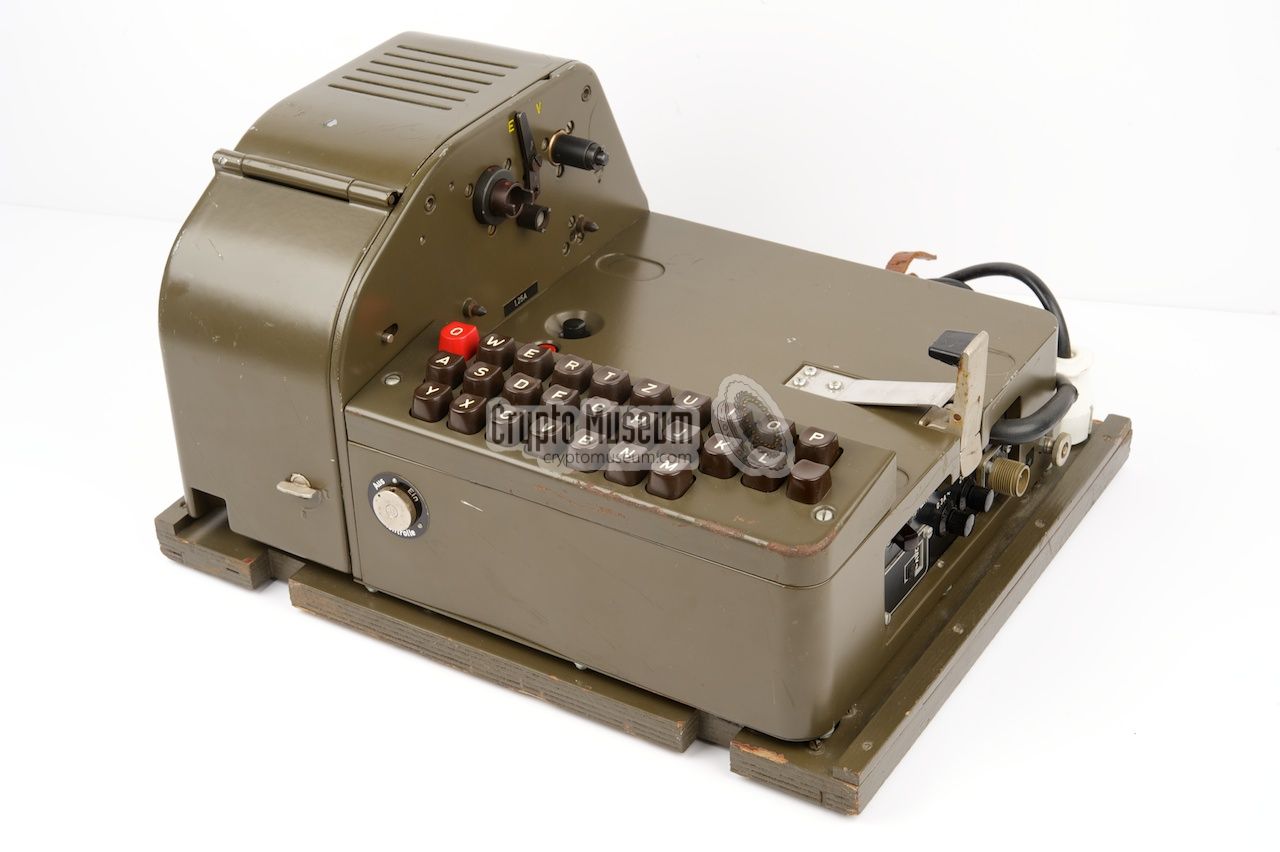
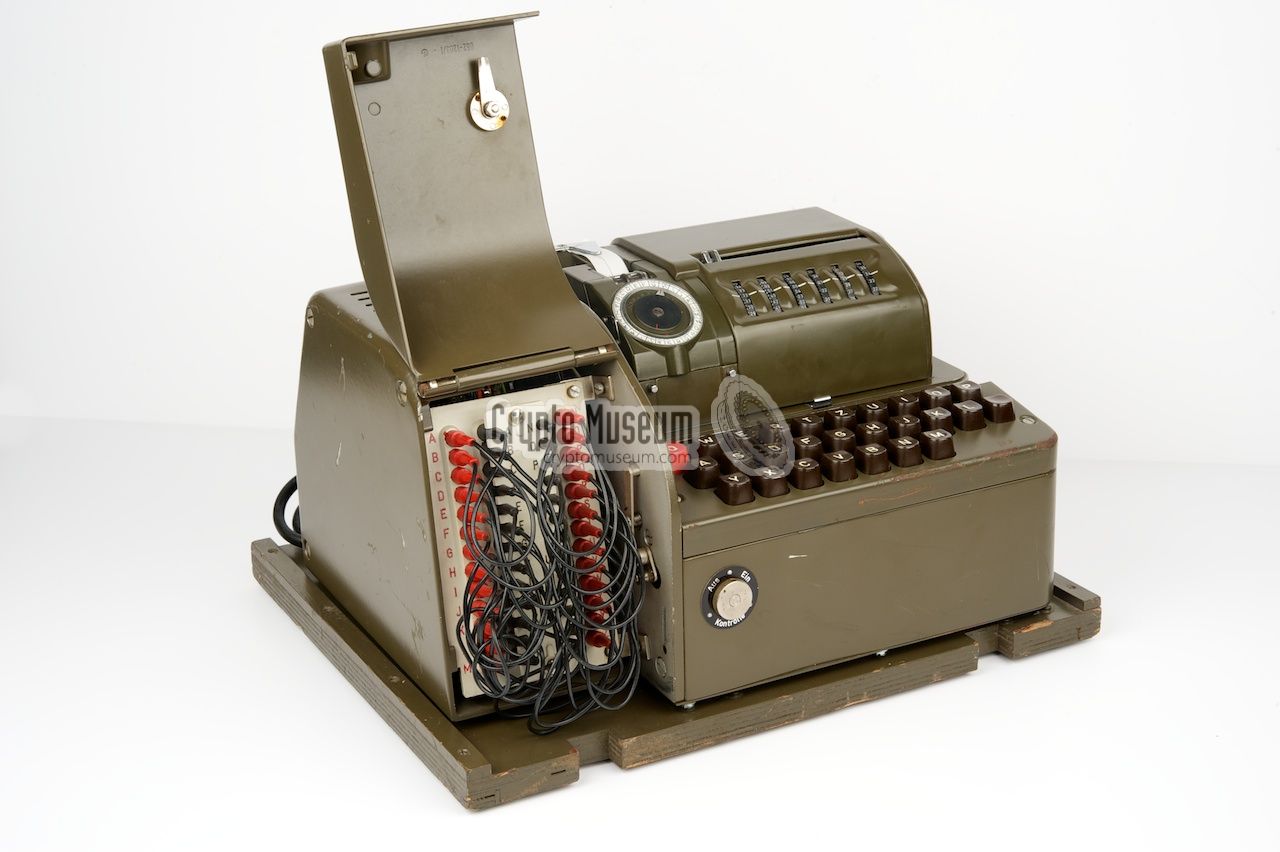
The B-62 consists of a large base
in which the motor and the various electronic and mechanical parts are housed.
At the right are the power switch, the fuses and the connection
to the AC mains (110 or 220V) or an external 24V DC source.
The mains cable is fitted permanently.
At the front right is a 26-button keyboard with the letters A-Z
in the German arrangment (QWERTZ). All keys are dark brown
except for the top left one which is red. At the right end of the middle
row is a blind key that is not functional. It is a spare one that is
bolted to the top panel.
|
|
|
Behind the keyboard is a horizontal bay in which the H-43 machine can be
installed. It should be fitted in such a way that the meachanical drives
at the left line up with the axles that stick out at
the left side of the H-43.
This way the transport mechanism of the H-43 can be driven, as well
as the letter wheel (at the front left of the machine). A small metal lever
can be used to toggle between ciphering and deciphering (in German:
(V) Verschlüsseln and (E) Entschlüsseln).
|
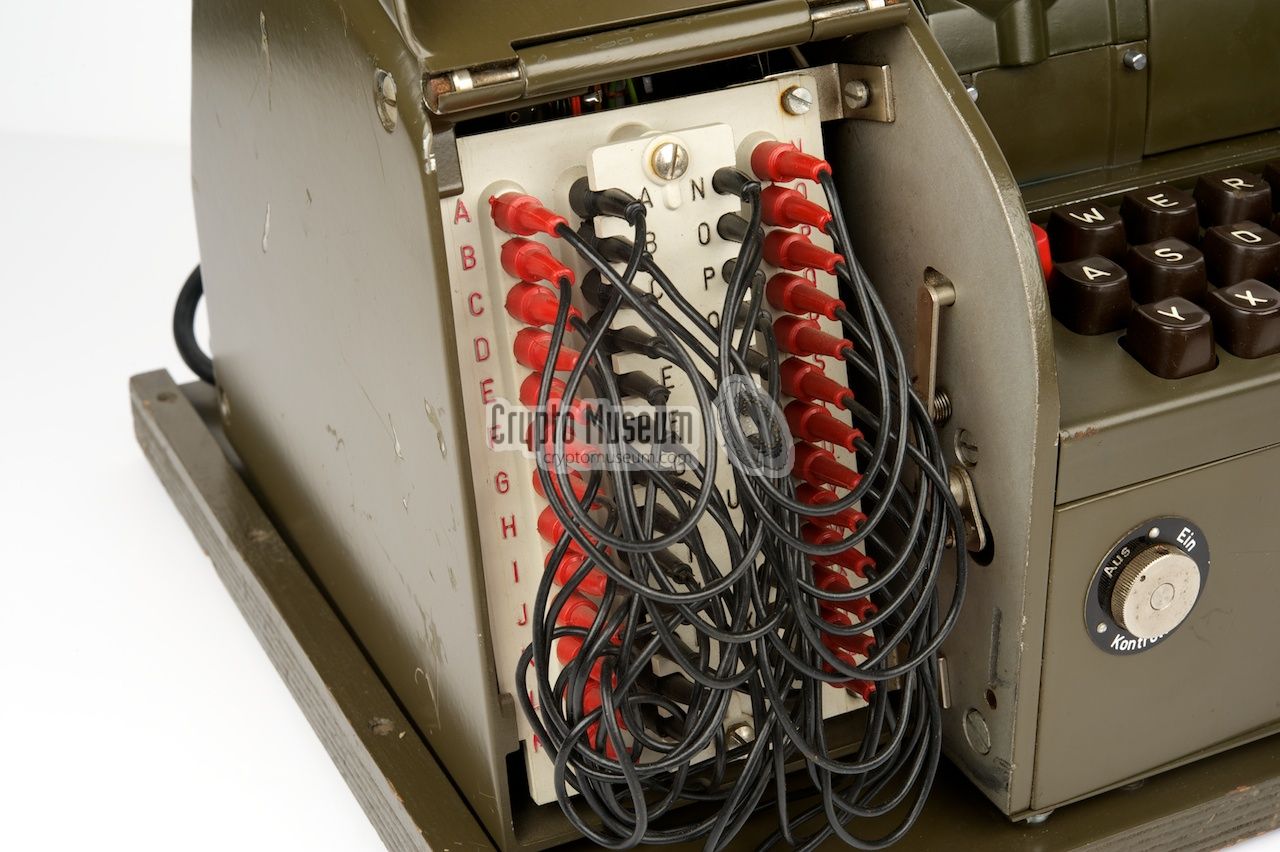
At the front left is a large 'blob' with a
hinged panel that swings open
upwards. Behind the panel are four rows of 13 banana-type sockets. The
26 sockets in the outer two rows are red and are marked with the letters
of the alphabet (A-Z), whilst the 26 sockets of inner rows are black.
The black sockets are also marked with the full alphabet (A-Z). 26 patch
cables are used to connect the red sockets to the black ones.
The patch board added an extra layer of permutations to the cipher
algorithm and is the equivalent of a transposed alphabet ring.
|
|
|
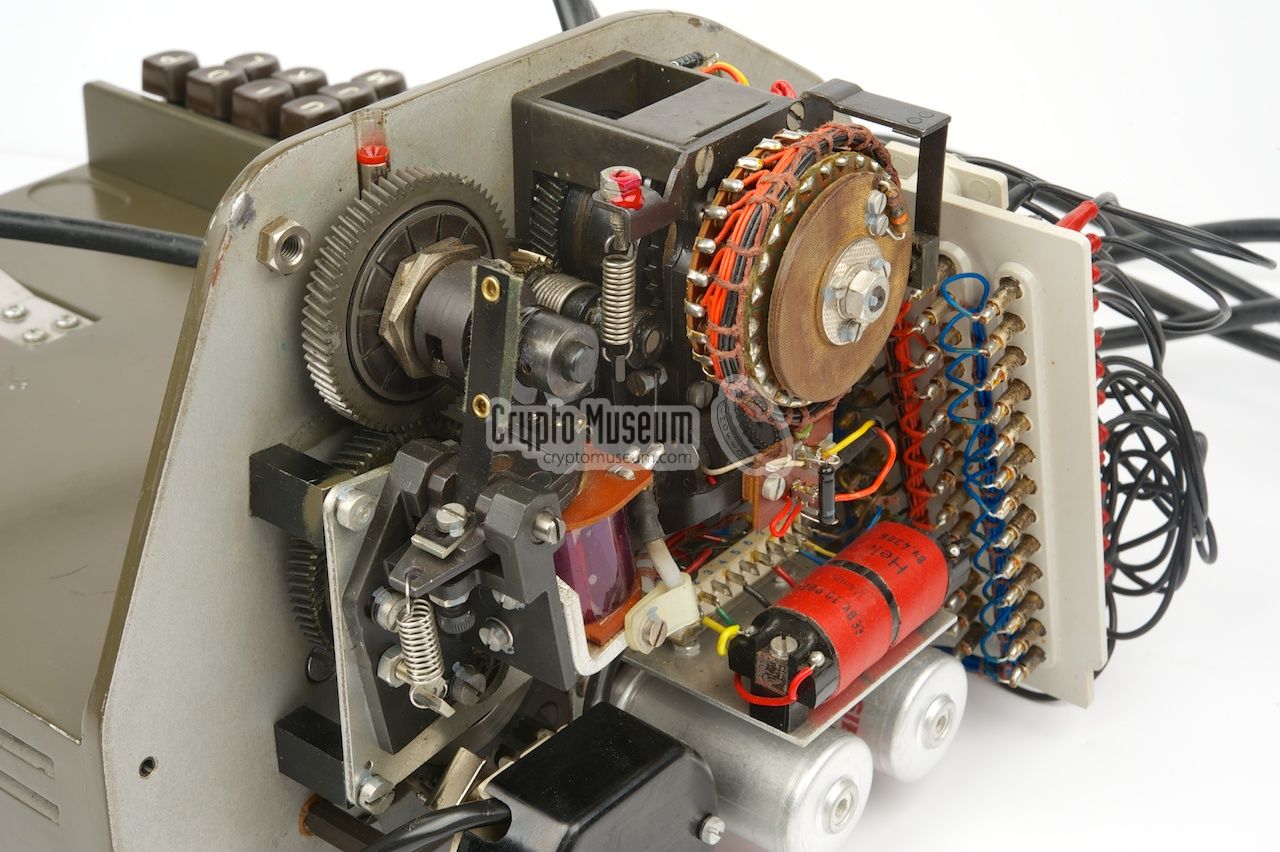
The area behind the plugboard, houses most of the
electro-mechanical parts of the B-62.
It can be accessed by removing the cover from the left side.
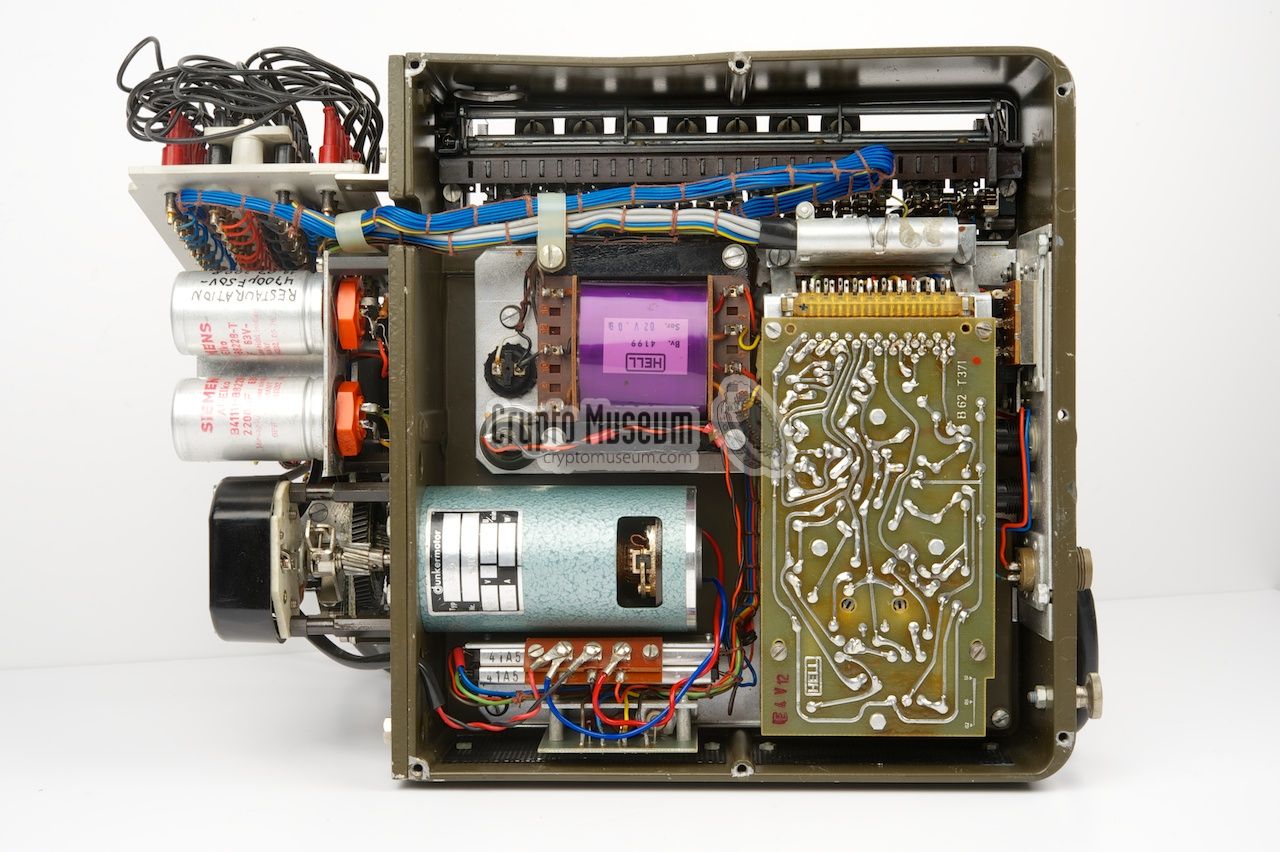
The bottom side of the unit contains
the transformer, the motor, the keyboard and the
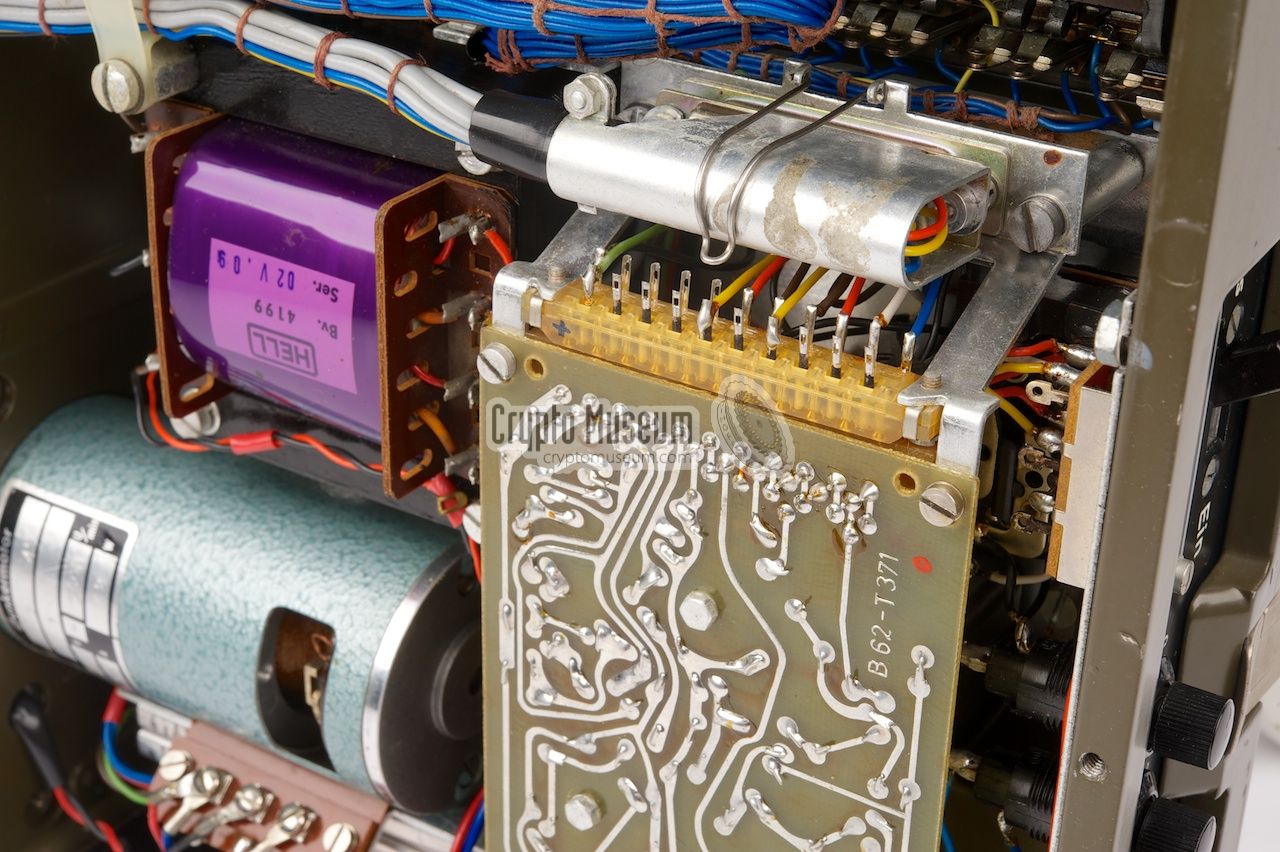
electronic circuits. The latter consists
of two PCBs with one of the first generations of transistors on them
(AC153). Considering the time it was built (between 1962 and 1965)
the quality of the printed circuit board (PCB) is extremely high.
|
|
|
|
|
|
|
Jim Meyer recalls...
During his time in the German Bundeswehr, Jim Meyer was assigned
to the German Army Signals Corps, where he was trained on the
HELL H-54 early in 1962 [1]. Because of the way the transport
arm of the H-54 works, the machine received the nickname
Kaffee-Mühle (coffee-grinder).
Later that year his unit was asked to test the
new B-62 keyboards under a variety of conditions.
For the test, soldiers with full NATO sucurity clearence had
been selected.
There were four complete systems, each consisting of a H-54 and
a B-62, that were tested for a full week, 24-hour per day
in 3 eight-hour shifts. Each operator would test the machine
for 8 full hours under hot and cold conditions, then sleep
for 8 hours, then perform another 8-hour test and so on.
The machine would be operated non-stop for 24 hours by pressing
random keys on the keyboard.
The tests were carried out south of Munich at Lake Starnberg
(near the Alps) in the shelter (Kofferaufbau) at the back of
a military MAN truck that was parked in front of the building,
guarded by two heavily armed soldiers.
Testing the machines under cold conditions was no problem,
as the test was carried out mid-winter
and the outside temperature was -15 °C
For the hot condition tests, two large professional hair dryers
were used. They were aimed at the machine until the metal could
no longer be touched.
This process was repeated for 24 hours: one hour cold and one
hour hot. Needless to say that both the H-43 and the B-62
passed all tests with flying colours and that it improved
the operational speed of the H-43 by a factor of 10.
|
|
|
|
Any links shown in red are currently unavailable.
If you like this website, why not make a donation?
© Copyright 2009-2013, Paul Reuvers & Marc Simons. Last changed: Wednesday, 01 May 2013 - 22:20 CET
|
 |

|
|