|
|
|
|
|

|
Portable cipher unit for civil applications
Miniflex was a high-grade cipher machine
developed by Philips Usfa between
1976 and 1982 in co-operation with German manufacturer
AEG Telefunken.
The small portable machine was used for encryption and decryption of text,
and was a cut-down version
of the NATO-issue Picoflex,
produced by the same manufacturers.
In all, over 300 Miniflex and Picoflex units were produced.
|
Miniflex could be used completely stand-alone and was powered by 5 penlight
batteries (AA-size). The user could type a message on the keyboard and read
the encrypted text from the display. He could then write down the cipher text
and transmit it via letter, telex, telegram,
morse code or by any other means.
Miniflex had the same expansion capabilities as Picoflex, but in practice
the most common accessories were the printer and the acoustic telephone coupler.
The radio modem was optional.
The image on the right shows the bare Miniflex unit, whithout any of its
accessories.
|
|
|
Although Miniflex was also available as a green military variant,
it was mainly intended for civil applications. It is therefore much less
sophisticated than the NATO-approved Picoflex.
The cryptogrphic algorithm
of the Miniflex is entirely implemented in software.
|
Miniflex was often seated in an executive style briefcase, that was commonly
used by business men in those days, and could therefore be carried inconspiciously.
It was intended for civil applications, such as diplomatic services,
international banks, oil companies, etc.
|
The image on the right shows a typical Miniflex configuration built into a
thin Samsonite case. The printer is bolted to the left side of the main unit.
The acoustical telephone coupler is fitted behind the main unit and connects
to it via a plug at the right.
Two black bags with zippers are fitted at either side of the telephone coupler.
They contain spare rolls for the printer and a mains adapter that can be used
instead of the batteries. The adapter was manufactured by Telefunken.
|
|
|
Miniflex could hold only one crypto key at a time. Each key was exactly 24
characters long (A-Z and 1-6) and consisted of 20 characters for the key itself,
one fill-in character and three for the indicator. The user would take the key
from a so-called key list.
Once the key was entered, Miniflex would respond with a 5-character code that
should match the checksum in the key list.
After that, the operator could encrypt or decrypt a message off-line.
|
Both the cipher text and the plain text could be printed on the (optional)
thermal printer that was attached to the left of the main unit. The text
is printed in 5-letter groups and two of such groups fit on each line.
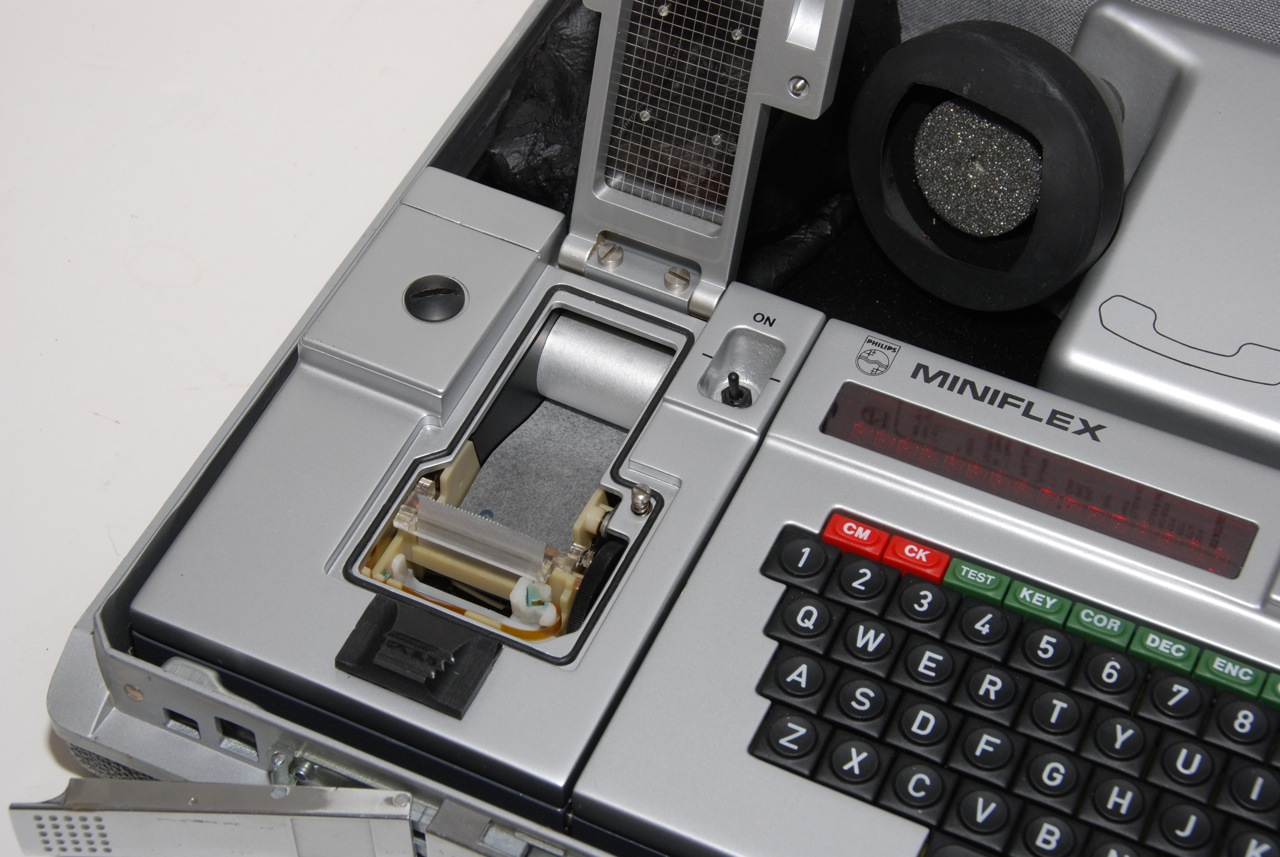
This image shows the printer with its lid opened. Inside the printer is the
narrow silver paper roll. The transparent lid has an embedded metal grid
that gives some degree of TEMPEST shielding. The printer has its own
battery pack and power switch.
|
|
|
|
|
|
|
|
|
Miniflex was a co-production between Philips Usfa
and the German AEG Telefunken. Whilst Telefunken produced the die-cast
aluminium case, the power adapter, the keyboard and the display,
Philips developed the electronics, i.e. the complete crypto-unit
and the central processing unit (CPU).
In order to protect the Miniflex against eavesdroppers, great care was
taken to ensure that the unit was TEMPEST proof.
This means that the case is well protected against unwanted radiation of
power and signals that could otherwise be exploited to recover the
original clear text.
The level of shielding found in the Miniflex was sufficient for
civil applications, but did not meet the military TEMPEST requirements.
Especially the thermal printer was notorious for producing sparks,
resulting in a high level of unwanted emission.
|
The Miniflex shown on this page, is a civil version of the device,
hence its silver colour. It was however, also available as a military
device, in which case it was painted NATO olive green and featured
military connectors.
It was intended for military use in non-NATO countries.
|
The military version of the Miniflex is featured in the 1983
full-colour brochure
[2]
of Philips Usfa BV.
The image on the right is taken from this brochure, and shows a Philips
engineer during the development of the military Miniflex.
In the image, the processor board is visible inside an olive-green enclosure.
The processor itself has been replaced by a Textronix in-circuit emulator,
which was used during the development of the machine.
Other photographs in the brochure [2] show the bare machine and an
example of its use by military personnel.
|
|
|
The military variant of the Miniflex was also sold by AEG Telefunken
as the Telekrypt-Mini.
This military version of the Miniflex (UA-8036) is not to be confused
with the far more secure Picoflex (UA-8035).
Although they are both housed
in the same case, Picoflex is a far more advanced cryptographic device,
approved for NATO Secret information, meeting full military TEMPEST
requirements.
The Philips Usfa brochure is available for download below.
|
|
|
|
Any links shown in red are currently unavailable.
If you like this website, why not make a donation?
© Copyright 2009-2013, Paul Reuvers & Marc Simons. Last changed: Friday, 01 February 2013 - 16:29 CET
|
 |

|
|