|
|
|
|
|

|
Off-line cipher machine with OTT
- Wanted item
Ecolex I was an off-line valve-based cipher machine for teletype signals,
developed by the Dutch Post Office (PTT) and built by
Philips Usfa in 1956.
The Ecolex I was the first Philips cipher machine
that used a On-Time Tape (OTT),
also known as mixers.
Approx. 25 units were built.
|
As far as we know, there are no surviving Ecolex I machines and the
photographs presented on this page are probably the only ones left.
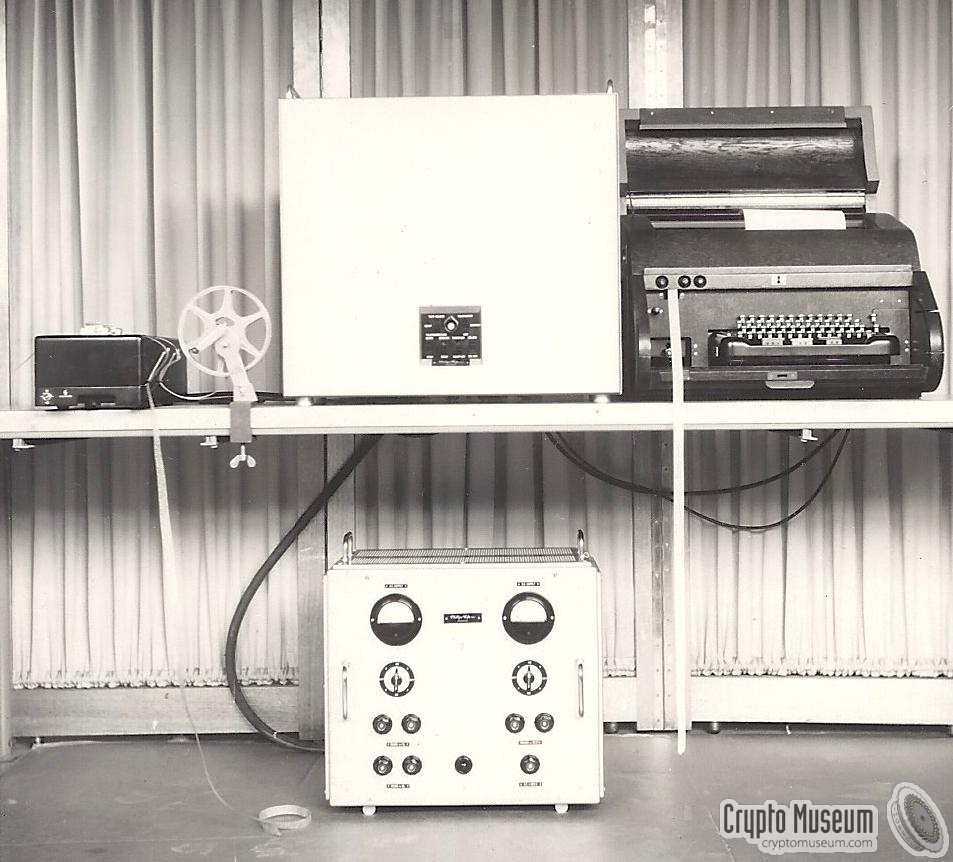
The image on the right shows a complete setup, consisting of a
Siemens T-37 teletype (left), a double Siemens paper-tape reader
(center), the Ecolex-I system itself (right) and a very
large power supply unit,
that was unually hidden under the table.
More images of the Ecolex-I below. In the fifth photograph below,
all 69 valves are clearly visible.
|
|
|
Cipher systems with an OTT
are generally called mixer machines.
With such devices, the key stream should at least be equally long
as the plain text.
Furthermore, it should be used only once and it should be destroyed afterwards.
The key tape was 'mixed' with the plain text stream using an XOR-operation,
also known as the Vernam Cipher.
When the Ecolex-I was used with a truely random key tape,
the code was unbreakable.
In practice however, the key tape was often generated by
a pseudo-random number generator (PRNG) rather than by 'noise'.
In case of the Ecolex-I, the key tapes were generated by the
EROLET, a
PRNG that was also developed by the PTT.
At present it is unknown how EROLET generated its key stream.
The Ecolex-I was succeeded by the fully transistorized
Ecolex-II.
|
- Photographs from Philips Usfa
Crypto Museum Archive.
- Philips Usfa, Internal Memo L/5636/AvdP/JG
23 August 1982, page 5.
|
|
|
|
Any links shown in red are currently unavailable.
If you like this website, why not make a donation?
© Copyright 2009-2013, Paul Reuvers & Marc Simons. Last changed: Monday, 04 July 2011 - 10:13 CET
|
 |

|
|