|
|
|
|
|

|
Key-tape generator
- Wanted item
EROLET was a pseudo-random number generator (PRNG), developed by the Dutch
Post Office (PTT) and built by Philips Usfa in 1959.
It was designed for the
creation of the One-Time Tape
pairs for the Ecolex-I
(and probably for other mixer machines). Only 10 units were built [2].
|
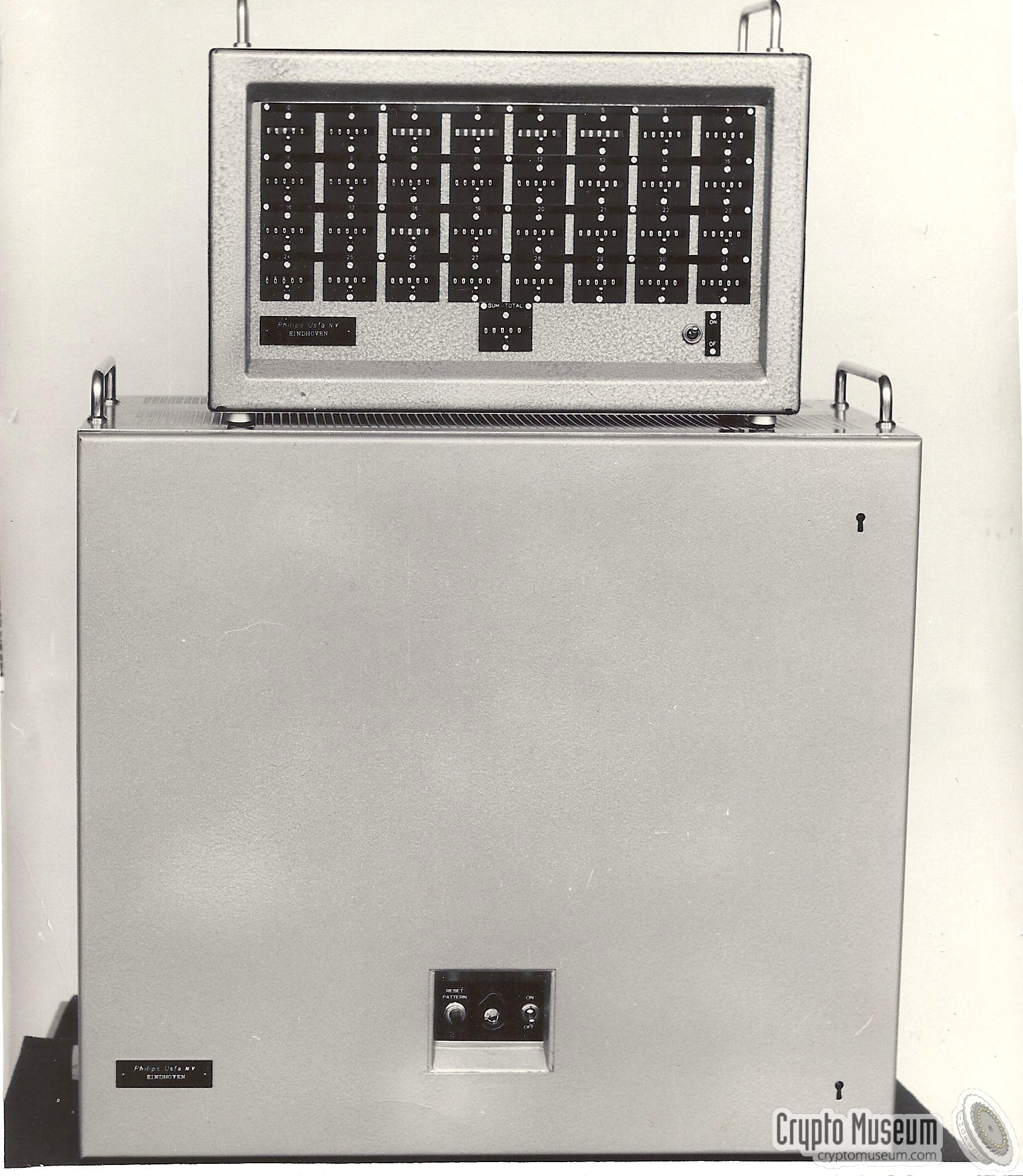
As far as we kow, there are no surviving EROLET machines and until now,
no photographs of it have ever been found. We believe however, that the
image on the right shows the EROLET as it was built by
Philips Usfa in 1959
[1].
The machine was housed in the same case as the Ecolex-I
and probably shared
parts of its circuitry. On top of the case is a cabinet with a series
of counters that were used to check the integrity of the system.
By counting the individual numbers generated by the PRNG, one could prove
that they were evenly spread. 32 counters are used to count each
of the possibilies generated by the 5-bit code (25 = 32).
Looking at the close-up,
we see that the counters are marked 0-31.
An extra counter at the bottom is used to count the total amount of
numbers generated.
|
|
|
Although we don't have any proof of it, it seems likely that the
power supply of the EROLET
was identical to that of the Ecolex-I.
With a One-Time Tape system (OTT),
key tapes should be completely
random and should only be used once.
Only two identical originals of the tape should exist.
No copies should ever be made.
After use, the tapes must be destoyed immediately.
For this reason, One-Time Tapes are usually generated in pairs.
The best way to achieve this, is to punch them simultaneously in a single
paper-tape puncher.
One of the photographs below, show a complex
paper punching system
that was built by Philips Usfa. It seems likely that it was used in
combination with EROLET.
|
|
|
|
|
|
|
Another way of producing two key tapes simultaneously, is by using
a Mils tape puncher. Mils is an Austrian crypto manufacturer, who
specializes in One-Time Pad (OTP)
and One-Time Tape (OTT) solutions.
The rightmost image above, shows a Mils puncher that was in use
at Philips Usfa at the time the Ecolex-I and EROLET were developed.
|
The Mils double tape puncher is shown in the image on the right.
Blank tapes are entered into the puncher at the right, where the two
reels are mounted horizontally.
Both tapes are lead through the same tape puncher, so that both
copies are identical.
Once punched, they are spooled onto two empty reels at the left.
In later years, Mils also developed double tape punchers with a
built-in random number generator. An example of that is available
on our page about One-Time Pads.
|
|
|
|
Much of what is presented on this page is pure speculation.
The information is largely deduced from old black & white photographs
found in the remains of Philips Usfa.
If you have more or better information about the items mentioned
on this page, please contact us.
Also, if you have other photographs or manuals, we'de like to
hear from you.
|
- Photographs from Philips Usfa
Crypto Museum Archive.
- Philips Usfa, Internal Memo L/5636/AvdP/JG
23 August 1982, page 5.
|
|
|
|
Any links shown in red are currently unavailable.
If you like this website, why not make a donation?
© Copyright 2009-2013, Paul Reuvers & Marc Simons. Last changed: Wednesday, 05 June 2013 - 23:21 CET
|
 |

|
|