|
|
|
|
|

|
Portable mechanical cipher machine
The CD-57 was a hand-held mechanical cipher machine, developed
by Boris Hagelin
and manufactured by Crypto AG in Zug (Switzerland)
around 1957. The device is compatible with the
Hagelin CX-52
desktop cipher machine and was small enough to fit in the pocket
of, say, a coat.
|
The device measures only 137 x 80 x 40 mm and weights about 1 kg.
It consists of a two-part die-cast aluminium enclosure in which all
mechanical parts are mounted at the bottom. The upper half is a
hinged lid that is opened by pressing a small button at the top
of the device.
The CD-57 was available in several civil and military versions,
all of which were fully compatible. It was available in grey (green)
hammerite and olive (green). The latter was often issued to the
military and is shown in the image on the right, together with
the manual.
|
|
|
The CD-57 was introduced around 1957 and remained in service until
the mid-1970s. In some countries it was used even longer.
Due to its small size and the fact that it was compatible with the
larger CX-52,
the machine became popular with a number of Armies
in Europe and elsewhere. The Austrian and the Swiss Army used it for tactical
messages for many years.
As the CD-57 could easily be concealed, for example in the pocket
of a coat, it became a popular encryption device with a number
of intelligence agencies, such as the French Secret Service,
during the Cold War. A special version of the CD-57 was produced
for the Vatican. Rather than aluminium and steel, it was layed
out in gold and ivory. The manufacturer, Crypto AG,
used this 'limited edition' also as a gift to special foreign visitors.
In the late 1950s and the early 1960s, the CD-57 was also built under
licence, as the STG-61,
by the German Manufacturer Rudolf Hell.
|
|
|
|
|
|
|
In order to obtain the maximum cipher period (i.e. the number of steps
before the machine repeats itself), each coding wheel (or disc) has a
different number of divisions and pins. Each pin can be placed in an
active or inactive position. The following 12 wheels are known:
25 26 29 31 34 37 38 41 42 43 46 47
Of these 12 wheels, only 6 are present in the device at any time.
Quite often, the machines were supplied with just 6 cipher wheels, e.g.:
29 31 37 41 43 47
In some situations, two identical wheels sets were issued with a machine.
It allowed the operator to prepair the alternate wheel set for a new key,
whilst the old key was still in use. When the key was changed, e.g. at
12 o'clock midnight, all the operator had to do was swap the wheels sets.
The 'old' wheelset could then be used to set the key for the following day.
|
In order to removed the wheels, it is important that the operating lever
is in the locked position (i.e. fully pressed-in and locked). Next, open
the case and swing the wheel locking spring to the side. The wheels can
now be lifted from their axle. Alternatively, turn the device over with
one hand and let the wheels drop into the other hand.
|
Setting of the cryptographic key, involves the following settings:
|
- Order of the coding discs
- Setting of the pins on each disc
- Start position of the wheels
|
Although there is no functional difference between the civil version
and the military version of the CD-57, i.e. both variants are compatible
and interoperable,
the device was available in two design variants: one painted in grey
hammerite and one with a typical military green (olive) finish.
|
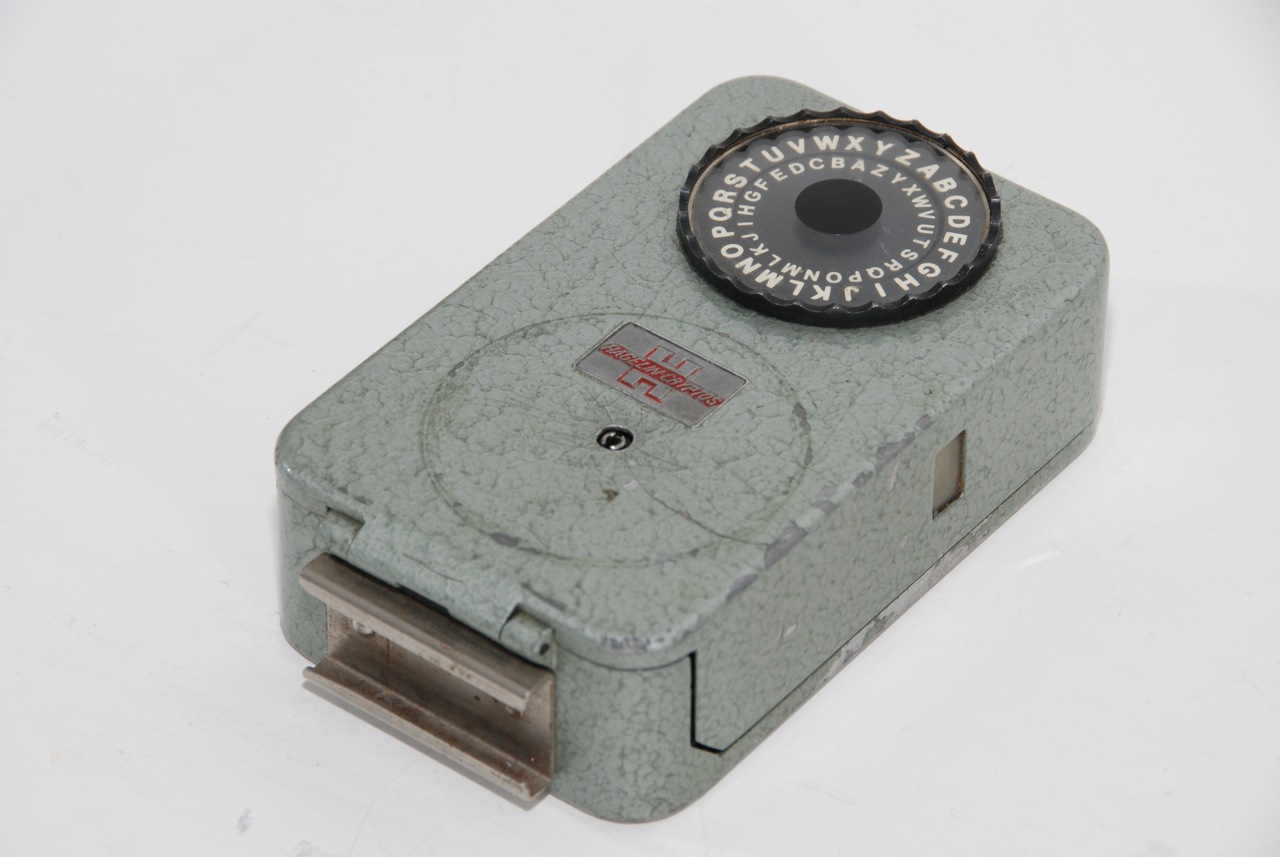
The grey hammerite version is generally identified as the civil version,
although it was also issued to some military customers, such as the
Austrian Army (see below). The image on the right shows a typical
civil version of the CD-57.
The device can be opened by pressing the small push-button at the top,
after which the hinged top half of the case can be swung away. The crank
for manually moving the coding discs is stored inside the top lid.
This version is usually supplied with 6 different wheels.
|
|
|
|
The military version of the CD-57 is operational identical to the
civil version (i.e. the two are fully compatible and interoperable).
In line with other army equipment, the machine is finished in
non-shiny green olive paint.
|
To prevent accidental opening of the device in a tactical environment,
most military machines have a different type of lock, whereby the
push button on top of the device is replaced by a curdled knob.
In order to open the device, the knob should be rotated clockwise.
|
The Austrian Army used the civil version of the CD-57. In their case, the
units were painted in a grey-green hammerite finish. The color was
sligtly more green-ish than the standard civil (grey) variant.
Whether this subtle difference in colour was deliveratly choosen
for the Amry is not known. It is also possible that it was just
a variation in paint colours.
|
The image on the right shows a typical CD-57 that was issued to the
Austrian Army. Judging from the large circular scratch on the top
surface of the device, it has seen quite some action. The scratch
is caused by operating the manual crank.
The interior of this machine is still in excellent condition,
which proves that it has been maintained well during its operational
life.
|
|
|
|
Each CD-57 can easily be converted from an algorithm-based
cipher machine into a one-time pad cipher machine,
simply be replacing the coding discs by the so-called
RT unit. RT stands for Random Tape. Using a properly
generated random tape, makes the machine truely unbreakable.
|
The CD-57 was also built under licence by the German manufacturer
HELL,
who designated the machine STG-61.
Although the STG-61 pricipally is a straight copy of the CD-57,
the Germans managed to squeeze-in a few modifications and improvements.
 More information More information
|
|
|
|
|
|
|
Any links shown in red are currently unavailable.
If you like this website, why not make a donation?
© Copyright 2009-2013, Paul Reuvers & Marc Simons. Last changed: Wednesday, 07 May 2014 - 13:43 CET
|
 |

|
|